
A-roving, a-roving

paste

There was a time when you could travel from Balham (if you lived there) to (almost) the outer limits of the Universe (as long as a London Transport bus went there) for only ten bob.

A Red Rover was a frequent purchase for me and my mates in the late 60s, early 70s; a time when we were young teenagers and had irresponsible parents who’d cast us onto the streets, armed only with ten shillings, a Tupperware cup full of Coke and or milk (depending on how nauseous you wanted to get), a Penguin and a selection of (one) sandwiches made with the pride of the Shippam’s factory.   Travelling from Balham, most of our packed lunches had been consumed by Clapham North.

I had a paternal aunt and two cousins who lived in North Harrow (which, when looking at the bus map at Balham Underground Station, might have been outside the Universe, let alone at its furthest boundary). I decided we should take a selection of ostensibly twenty buses and go and visit my dad’s remote family.  It seemingly took several weeks but, having successfully arrived, starving by this point as we’d mistimed our food intake (which is why none of us joined the Commandoes), we discovered they were out.  No mobile phones those days to say: “Hi, Auntie Betty, we’re coming to visit”, not even a couple of old yoghurt pots to communicate our impending arrival.  So, skint, hungry and tired we ventured back to south London with my friends assuming this extended family didn’t exist.

I go nowhere these days without the aforementioned yoghurt pots (in case of emergencies) and always have a ten-shilling note hidden inside the secret heel of my shoe – the one next to the beaver footprint.

“Is there a doctor in the dry cleaners?”

emergency

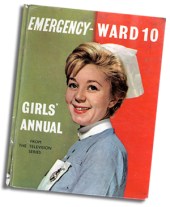
It was watching Emergency – Ward 10 that I decided I was probably not best cut out to be a doctor.  Even in black and white, blood looked pretty gruesome. However, I’m sure the ITV series which ran for a decade between 1957-1967 inspired many people to be asked “what’s the bleeding time?”

In the 60s there was precious little TV choice; even when the third channel, BBC2, was added in 1964.  Although, as a seven-year-old, this seemed to involve watching lots of men with beards sitting around talking about the meaning of life – very late at night; in the 70s, if you couldn’t sleep and turned the TV on you’d be confronted by (probably the same) men wearing tank-tops and shirts with collars nearly touching their elbows pointing at complex charts or doing unspeakable things with pipettes.

However, in south London, with careers officers at school telling you to be a secretary if you were a girl and an armed robber or accountant depending on which type of boys’ school you attended, TV could have possibly given that much-needed career-inspiration? Perhaps All Gas and Gaiters encouraged people to join the church or a Reg Varney-induced moment would have made being a bus driver appealing, although running a motel in the Midlands wouldn’t have been attractive as you’d be forever sorting out the love life of the village idiot.

TV did inspire me and, despite having often seen the actor who played Mr Verity in Balham Sketchley’s, I have enjoyed forty-plus years working in the Home Guard.

Russian fly in the ointment

thrush

I was seven when The Man from U.N.C.L.E. first aired on the BBC.  I immediately wanted to be Napoleon Solo and sent off to become a member. A few days later, with membership card proudly in my hand, I believed I would be a master spy before I took my Eleven-Plus.

During the series I always had my concerns about Solo’s sidekick, the enigmatic Illya Kuryakin; consequently, I wasn’t really surprised when he popped up, dressed as a British RAF officer, in Colditz – but that’s why Russian spies are so clever and clearly have a variety of seamstresses working tirelessly in their Gulags.

As a seven-year-old the name of U.N.C.L.E.’s nemesis, T.H.R.U.S.H., meant nothing to me. I’d yet to buy my first Observer Book of Song Birds and was unlikely to contract any sexually-transmitted disease (mainly because my mother told me never to sit on any strange toilets).  Looking back, Napoleon and Illya were unlikely to quash their arch-enemy by rubbing a soothing ointment on them.  Although eradication was the name of the game, I guess.

The show which rivalled The Man from U.N.C.L.E. on ITV was Danger Man – I also wanted to be John Drake and would stalk the corridors of my Balham block of flats seeking out enemies of the state (I suspected most of the cleaners and believed that inside their mops lay a selection of east European munitions).

Danger Man would occasionally feature cameo roles from famous actors, one episode featured John le Mesurier; I never wanted to be Sgt Wilson, but in increasing old age, can identify with Private Godfrey and his constant desire for the toilet; today I am more great uncle rather the Man from!

Deeper throat

barley sugar

I’ve not had barley sugar since 25th May 1967.

My nan had a cupboard like a confectioner’s and contained an assortment of sweets primarily designed for sucking. If there’d been a warning fifty-one years ago on one specific packet I’d have not missed Cubs.

Dressed in Cub shirt, adorned with collector’s and signaller’s badges and newly-won felt sixer’s appendage, shorts, socks (together with garters holding them up) and woggle in correct position (enter your own gag here), I was all prepared to shout “dyb, dyb, dyb”, play handball, run like a Banshee round Balham Baths’ adjoining hall and splatter over-cooked sausages to every part of the hall’s kitchen, my nan proffered me one last sweet from her store.

I’d never had barley sugar before and felt it would make a change from her usual offering of Acid Drops or Callard & Bowsers Toffees.  It would be the last time too as, after a nano-second, because it stuck in my throat.   The natural melting time for a barley sugar boiled sweet is around the best part of a decade (the time it felt this thing was stuck in my throat).  Cubs had to be attended at all costs, if only to see how far up sausages on too high a gas would ascend into the air.

I spent, ostensibly, hours and hours, being fed water as hot as possible to try and melt the stubborn barley sugar – was suffering third degree burns in my throat worth not being shouting at by Akela?

Eventually the sweet melted sufficiently for it to move through my throat. Cubs had been and gone and the sausage safe for another week before I returned as a maniacal Fanny Craddock.

I sat down, relieved;  my nan to put the TV on – the 1967 European Cup Final between Celtic and Inter Milan was taking place. I had been a hero like the Celtic players that night.  Less than a week later I saw, in the Radio Times, they had the European Cup Winner’s Cup Final on TV.  Glasgow Rangers against some team which I’d never seen on the Big Match.  Perhaps I might bunk off Cubs again?

Personification of Evel

puch

I think it was Evel Knievel who once said: “You wait ages for a London bus, then fourteen come along at once”.  I was, despite owning a moped aged 16, never destined to follow the exploits of the master bus-vaulter.

In 1972, aged 15, my parents emigrated from Balham to Carshalton (it could have been Neptune, it seemed so far away). Transport back to family still in Balham would be a problem so my dad said he’d pay for me to get a motorbike.

Armed with a selection of Premium Bonds, illegal Singapore currency my dad had brought back after National Service and a handful of pretend coins from the Co-Op, I travelled back to SW17 to purchase a Harley Davidson.  Sadly, they never produced a range of mopeds, so an Austrian-built Puch Maxi S was procured.

The shop I visited on Garratt Lane, Tooting was called Elite Motors. Growing up in 60s/70s south London, “elite” wasn’t a word we’d heard much, so we unwittingly called the shop “e-lights” (the shop is probably now selling vaping mechanisms).

Elites did well out of me; I bought three bikes there. However, I was more Mr Sheen than Barry Sheene and after a succession of minor accidents felt there was some supreme being telling me it was time to learn to drive.

On my travels back and forth from Balham to Carshalton, I remember vividly riding through Mitcham Common and the temperature dramatically dropping several degrees. I could have ridden blindfold and known exactly where I was – although this would have consequently entailed more arguments with the bridge over Mitcham Junction Station!

I miss not having a bike, although my most embarrassing biking moment is still etched in my brain: having toppled over at Amen Corner, Tooting, I was asked by a frail, old woman if she could help get my bike upright again? It was at this point when I realised that old people act as very good fulcrums!

I won’t ever be attempting vaulting over buses any time soon as my Red Rover is about to run out.

Not a sniff

pollen

Hay fever was the reason I failed my O-levels. I should know, I’m a doctor, well, I once owned a plastic stethoscope from a 1960s doctors and nurse kit.

The hay fever season has returned to these shores (probably from Russia); I remember back to being sixteen in 1973, sitting my O-levels and contracting, for the first time, Allergic Rhinitis – which is the correct medical term for hay fever and not the name of the cross-eyed rhino in Daktari.

My desk, inside the hot, imposing, alien school hall on Battersea Rise, looked more like a chemist’s than a work station. If I’d had a bottle of ointment to treat marsh ague, some pampers and a box of prophylactics I could have rivalled Balham Boot’s!

I’d never had hay fever before and went to every exam armed with pen; Piriton; a Penetrol inhalant – which unblocked noses with power like that of a flame thrower; paper hankies; cloth hankies – all with a big “M” on (and a diagram of an oxbow lake, which I’d sewed on the night before my Geography O-level) and lucky (or not in this case) Gonk!

I also had a slide rule which proved more useful during my music O-level – underlining the name Chopin – than it did when I sat my maths O-level!

Despite having a desk which resembled that of a fifteenth century alchemist (I could turn base metal into Kleenex) I didn’t do very well with my science exams.  Not so much not knowing my arse from my elbow, I didn’t even know my amoeba from my elements tables.

Gesundheit!

Gloves aren’t off

Sooty

I was told, after winning a new client, that my presentation had been “entertaining”. The person telling me this hadn’t actually been at the meeting, but they had heard and asked why?

“I used several glove puppets,” I replied.

I hadn’t, but it did remind me of my (rather too many for a boy) massive collection of soft toys I’d accumulated as a kid – including many glove puppets.

I have an early picture of me, aged four, throttling Sooty. As a kid, growing up in the sixties, many of the childrens’ programmes I watched invariably had glove puppets as part of the merchandise.  I was never that interested in string-puppets (although Muffin the Mule had been legalised by the time I was ten in 1967) but my loyalty remained with things you could stick your hand into (I should have been a vet rather than choosing a career in advertising).

My favourite was Willie Wombat (still illegal in some States in the US) – Willie Wombat was to Tingha and Tucker as Knots Landing was to Dallas.

As an only child, and with a collection of glove puppets large enough to form several football teams, I would invariably re-enact big football games in my bedroom (although doing this didn’t stop me having bad eyesight!).

One evening in mid-June 1970 Willie and Wendy Wombat became Gerd Müller and Uwe Seeler and snatched three late goals for a very antipodean-looking West German team against an England XI consisting of Sooty, Sweep and Sue as the front three. No contest.

I’m still technically a member of the Tingha & Tucker Club. The newsletters have dried up due to Tingha and Tucker moving the America to work on a koala stud farm.  However, if ever I feel nervous I simply sing Auntie Jean’s Wibbly Wobbly Way.

Next week: Why Twizzle defies every aspect of modern day health & safety.

It’s in the jeans

nun

I’ve never owned a pair of blue, denim jeans.

I’m probably in that 0.01% of the world’s population where a pair has never been in my wardrobe, but I was never realistically given the option.

Rather than spend money on a pair of Levi’s or Wrangler’s, the only option to me was the Tesco Home ‘n’ Wear on Balham High Road.

As a teenager in the early 70s, I earned no money, so was reliant on my mother as my clothing benefactor. This benevolence sadly only stretched the 500-yards from our flats on Balham High Road to the non-food Tesco shop further down the road – not for me anything from Reno, Nevada or Greensboro, North Carolina!  Tesco Home ‘n’ Wear, Balham was the only choice.  A consequence of this non-option was that I never owned a pair of blue denims from a famous brand.  The only thing shrinking in my bath as a teenager might have been blue, but certainly wasn’t made out of denim.

The same fate struck me with shirts. I so wanted a Ben Sherman shirt; the option I was given was one from Trutex (might as well have been Artex – arguably more fashionable and at least I could have covered my ceiling with it).

Trutex was to Ben Sherman what Hot Hits and Top of the Pops records were to the songs’ original artists.  Similar, but the collar, designed like the hat on The Flying Nun, gave it away that it was not the real thing!

I’ve never been that fashion conscious – probably scarred by the disastrous Haute Couture forced on me as an adolescent.  To me, as a teenager, a Kaftan was a dog known for its long, shiny hair; flares were things you activated if marooned at sea and (until Eurotrash was aired on Channel 4) I thought Jean-Paul Gaultier was the best full back Paris Saint Germain ever had.

An imaginary bunny is not just for Easter

old-pliers-stock-picture-3428613

I first encountered the Tooth Fairy in 1961.

I never actually met her (or him) (and assumed they lived in my Balham block of flats as you wouldn’t have wanted to walk down the High Street in the middle of the night) but was told that he/she or it carried sixpences to replace missing teeth. I worked out, in a JP Morgan-type of way, that I could stand (or lie, as I was invariably in bed when the Tooth Fairy visited) to eventually gain ten-bob, as I had twenty baby teeth.

This was my first experience of profit and loss as my gain of sixpence per tooth was quickly negated by my mother charging me a shilling to protect me the night the Tooth Fairy was coming from the Bogey Man. By the time I started the juniors in primary school I was heavily in debt to my mother.

Sixpence is worth £1.14 these days. If you haven’t got a note for your child/grandchild then there is the danger of leaving sufficient coins under their Flopsy Bunny pillow to potentially cause copper, nickel and zinc poisoning.  Might this be something the Bogey Man could protect you from?

I was destitute aged seven as Christmas was also heavily taxed: the sledges needed to be hired (there was great demand at Christmas, so the prices artificially inflated); reindeers aren’t cheap to keep and I was told there was a congestion charge for sledges (even though this wasn’t enforced in London until 2003); plus, half a sprout and mince pie crumbs cost several guineas in 1961.

Obviously, approaching 61, I realise neither the Tooth Fairy or Santa exists (I discovered this aged fourteen – as if adolescence wasn’t tough enough) but today, if there isn’t a huge amount of chocolate for me, I shall be a very unhappy Easter Bunny.

If Bill & Ben met Pablo Escobar

flowerpot

Box sets are a relatively new phenomenon.

And Netflix doesn’t mean curtain twitching.

Until 1967, when BBC2 began broadcasting, the choice on your TV was threefold: BBC, ITV or OFF.   No video was connected; DVD sounded a bit like something you caught off a stranger’s toilet and satellite was what Russians had launched into space a decade earlier to spy on other countries rather than broadcast Home and Away.

In the 60s the only box you had was one to keep jewellery in – or a hamster if you were a boy. And binge watching didn’t exist unless that’s what you called viewing Coronation Street twice a week.

In the 60s there were no devices for recording, so if you missed an episode of a favourite programme, you’d be reliant at school/work the next day to be told loosely and inaccurately what Meg Richardson had been up to – without sounding too much like Benny.

I wonder what it might have been like in the 60s if box sets had been available?

Could you have watched Emergency, Ward 10 for five hours at a stretch? (that’s an awful lot of catheters).

And what if the Flowerpot Men’s garden had been set in Medellin, Colombia and Weed really was weed?

And rather than watching both series of The Crown back-to-back, the only time you actually saw the Queen was on Christmas Day – although if she’d have discovered how to make crystal meth before Prince Charles was sent to Gordonstoun, you could have merged several series into one and saved valuable viewing time.

I started watching The Wire, but gave up when I discovered it wasn’t about an electrician.