Flagging a dead horse

semaphore_flags_nylon

Before email, people would communicate with one another using semaphore flags.   Luckily for me, in the late 60s (just before the invention of email) one of the badges available for attainment within the 3rd/14th Balham & Tooting Cub Group was a Signaller’s Badge.   There was an option of learning how to work an Aldis lamp, but we were poor and couldn’t afford the giant light bulb.

Having created two flags out of an old pair of red and yellow pants (they were never going to become fashionable) and a couple of Mivvi lolly sticks I was sent by Akela (the she-wolf who ran the Cubs) to a house in Holdernesse Road, Tooting, to learn how to spell out H-E-L-P-M-Y-B-O-A-T-I-S-S-I-N-K-I-N-G.

The house was owned by the father of a fellow pupil at St Mary’s, Balham, and the dad’s ability to send messages using flags meant there was no ostensible need for a telephone (there were, however, several discarded yoghurt pots and bits of string strewn around the house – in case of emergencies, the father would say).

The badges available these days for Cubs are manifold: Entertainer (I’ve done 50 stand-up gigs, so feel over-qualified); Home Help (I bought a duster on the doorstep last week and have almost mastered how to use it) and Local Knowledge (I pointed out where the Gents was on Ewell East Station the other day). If I were a Cub today I’d have an armful; as a Cub in the 60s, I achieved two badges – Signaller and Collector (dad was a prolific smoker and acquired boxes of matches which I would collect and stick in a scrapbook).  It was the smelliest submission ever, said Bagheera (Akela’s deputy).

I never graduated to the Scouts as cooking was introduced towards the end of my Cub career and this looked potentially quite dangerous with sausages clearly having a mind of their own.

As you get older, you hark back to the “good old days” and I sit in my office praying for the Internet to go down, because I never need an excuse to get my semaphore flags out. This is not a euphemism.

And smile!

It was after the 1964 Farnborough Air Show that I decided not to a pursue a career as a professional photographer.  I was seven in 1964 and had been given a second-hand Box Brownie camera by my parents.

A Brownie camera was a cumbersome device which was operated nearer your groin than your eye. Unlike cameras of today, where the resulting images are immediate, in 1964 you were beholden to the local chemists (to the tune of about three weeks) on the outcome.  

In 1964 a selfie wasn’t a photograph, it was something your parents warned you would eventually make you go blind. 

By 1964 the Box Brownie had been around for sixty-four years, so wasn’t exactly in the forefront of camera technology. Lord Lichfield used his to prop up a wonky table.

At the time of the 1964 Farnborough Air Show I was invited by a fellow classmate at St Mary’s Balham, who lived in Streathbourne Road in Tooting, to join him and his parents in his parents’ Austin Cambridge to travel to the Hampshire village which hosted, every other year since 1948, the world famous air show. Packed off with Kwells and thermos flask full of chicken soup, I was allowed to take my camera.

If George Eastman had known how I was about to crucify his industry, he’d have never have invented Kodak. 

We travelled to Farnborough; I took my full reel of twenty-four pictures; I wound it on after every shot; I never exposed the film; I’d not covered the lens with my hand (or penis – not that I was doing this naked); I’d carefully removed the film; proudly presented the film to the man in Boot’s on Balham High Road and prepared to wait the mandatory three weeks (waiting for my O-level results was not as excruciating – although the results equally horrific).

At the end of the three weeks I walked from my flats the other side of Balham Station to Boot’s on the High Road to collect and revel in the fruits of my labours of recording one the world’s greatest air shows. 

I paid my money and looked at my twenty-four individual efforts. I saw twenty-four minuscule black specks on a grey background. My attempts to capture the beauty of the then new VC10 had failed miserably. I’d have had a better definition on a photograph if I’d having been standing in Farnborough photographing an ant walking along Streathbourne Road.

A year later, David Bailey released his iconic picture of the Krays; it was this harsh reality which decreed I was never going to make it as a professional photographer. I have never picked up a camera since and am only grateful I never watched Tony Curtis’s portrayal of Houdini.  


Swearing in

Testcard_F

We were late getting a colour TV. I was nearly twenty before I realised snooker didn’t involve varying shades of grey balls.

In 1970, when I was 13, colour TVs were the domain of the rich – or if you had relatives working for Radio Rentals.

In the sixties and seventies, when I was growing up, very few people owned their own set.

We rented a series of black & white sets from Mr John in Balham Station Road. Although I never ran our family finances, we never seem to pay for any of the sets’ rental or maintenance.  Saying that, my mother’s way with most of the traders in Balham & Tooting ensured we never paid for that much.  It would appear, with Mr John, that payment enough was simply listening to him talk.  And he could talk.  He knew 1,001 things to do with a burned valve.  He would regale you with these uses during most visits.

On 11th April 1970, my dad and I were invited to watch the FA Cup Final pitting together the Lionel Messi-esque players of Ron Harris of Chelsea against Billy Bremer of Leeds in colour. We knew the owners of the colour TV, they ran the hardware shop, HH Thomas & Son on Balham High Road.  The owner wasn’t a massive sports fan, but knew of dad’s Stamford Bridge allegiance, hence the invite.

Despite having a senior job in advertising and being well-read, dad was staggeringly vituperative. He made Roy “Chubby” Brown sound like Mother Teresa.

Chelsea went 0-1 and 1-2 down and as Jack Charlton’s mis-timed header went in, and Mick Jones’ quick reaction follow up to Allan Clarke’s assist, my dad was clearly having some mental Davina McCall moment as someone somewhere was imploring him not to swear.

(Dad was bright enough to be accepted to have an audition for “Fifteen to One”. Sadly, because of this massive swearing vocabulary, he failed the audition).

18-days later we watched David Webb, in his Royal Grey shirt, bundle the ball over the line to win the replay for Chelsea, in the comfort of our own flat, together with dad’s mandatory 40 Senior Service. It was better for dad’s health that he could eff and blind at home, rather than teaching the children who lived above the hardware shop to learn words they never knew could be used as verb, adjective and adverb all one sentence and so many times over 120-minutes.

I can’t remember when we finally got a colour TV, but this didn’t matter as mum’s favourite programme was The Black and White Minstrel Show, so it was academic how sophisticated our TV was.

A relay baton is not just for Christmas

tooting running track

I was never going to be Balham’s answer to Jessica Ennis; although I did enjoy the annual sports day during my final year at St Mary’s, primary school, Balham. It was our chance to become the next David Hemery, Bob Beamon or Mary Peters if you were big-boned (I enjoyed her singing duo with Lee).

Reports of my ever-decreasing sporting career has already been written about here: https://mikerichards.blog/2017/02/26/odd-shaped-balls/

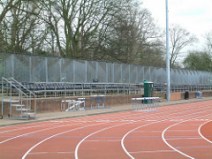
Our school sports day was not within Beijing’s Bird’s Nest or under the record-breaking sheets of Perspex construction which is the Olympic Stadium, Munich. No, we walked to what is now called Tooting Bec Athletics Track & Gym.  In 1968, the year of our sports day, it was a dilapidated cinder running track where the caretaker was called Jim.

It was the only year and only activity when we were divided into houses, a foretaste of being in Delta House the next year for my first year at Bec. I look back and wonder why we weren’t named after famous people who’d lived in Tooting: Hardy; Lloyd George; Gibbon; Harriott? (OK, I get why).

We undertook all the normal races: 100 yards (the only meters in SW17 in 1968 were the ones you’d put half a crown in for the heating); 200 yards; the relay race (with a sherbet fountain being used as a relay stick) and, because we were only 11, the three-legged race.

There were fifteen boys and fifteen girls in our final year, the three-legged combinations was quite egalitarian. I was partnered to a girl (soppy though that may seem to any eleven-year-old reading this).

I’d been taken several times to my dad’s place of work (an advertising agency in Gloucester Place) a consequence of which was that, when I grew up, I wanted to be part of this Mad Men world. My three-legged race partner wanted to be a golden retriever!

Ostensibly this is a major advantage: faster over 100 yards, more desire for running and a wet nose (handy extra moisture if there’s a photo-finish). Sadly, there were disadvantages too – she wasn’t a bloody golden retriever being the most obvious (ironically she was prone to puppy fat).  Also, I was 11, theoretically, my partner, mentally, was 77 years old. Not a good age for sprinting.

The prizes were bars of chocolate for first and packets of Spangles for second and third. Sadly, my partner was not incentivised as she was after some Winalot or a tin of PAL (Paired with A Looney).

Ironically my three-legged race partner craved a career in advertising but failed to get in the Andrex ads as she had a fear of quilted paper. I believe she is doing stunt work in the backs of cars selling insurance.

If you have a sports day coming up, don’t partner with someone who wants to be a golden retriever when they grow up – get someone who has aspirations of being a whippet or a greyhound and get one of their parents to throw a pretend rabbit at the finishing line.

Orange is not the only coach

orange

As a teenager, and because we didn’t own a car, I would spend many a Sunday afternoon in a coach, destined to a variety of stately homes in Surrey, Sussex and Kent.

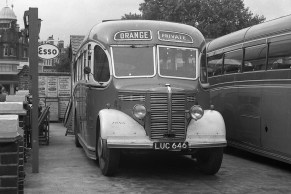
We would travel with Orange Luxury Coaches from Eaton Garage, at the bottom of Marius and Balham High Roads.

I was, by the time I was 13, the only person in my class who knew that the main resident of Penshurst Place (a popular venue) was Sir Philip Sidney; several of my classmates, when talking about “what did you do at the weekend?”, thought he may have played for Red Star Belgrade.  (He didn’t, as he had a career-ending knee injury whilst writing Astrophel and Stella)

I assume the reasoning behind my dad’s thinking was that these journeys would improve me? In my opinion, watching the John Player League on the TV would have improved my leg-breaks.

The destination was always known in advance; we never ventured on mystery coach tours. One mystery to me, given, in my humble opinion, most of my fellow-travellers must be over 200, if they were a day, was how no-one ever died en route.

The coach driver would always count everyone back onto the coach. It still puzzles me to this day how we’d still not be on a 99% full coach waiting for a double centurion not to have made it back due to collapsing amongst Anne Boleyn’s begonias at Hever Castle!

Another abiding mystery also remains: wherever the destination, in any of the southern-eastern Home Counties, the journey home was always broken by stopping off at The Black Eagle pub. This pub was situated near the vaguely amusing (if you were a teenager and had borrowed his mate’s Boys and Sex book) Badger’s Mount; and near, which I always, in a child-like way thought even funnier, Pratt’s Bottom.  We could have travelled to Whitby Abbey, we’d have still visited The Black Eagle!

I believe, in the days before Sat Navs, that all Orange Luxury coach drivers were descendants of King Arthur and The Black Eagle lay, like a series of Neanderthal burial mounds in SW England, on a ley-line linking Balham High Road and Ightham Mote.

The Black Eagle no longer exists, but if there had been an eighth ancient wonder of the world, this would have been it. Should have been in the top seven as you never got chicken ‘n’ chips in a basket at the Hanging Gardens of Babylon!

To bin or not to bin

rubbish

When I was a kid, recycling meant taking your bike on a journey you’d made before.

Nowadays, courtesy of Al Gore (one of few celebrities never to have lived in Balham), we’re asked to save the planet; one way, other than using less deodorant, is to have different receptacles for differing items of rubbish.

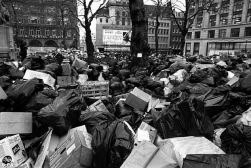
In Du Cane Court on Balham High Road, on every floor, there was a room, inside which was housed the “dust chute”. You gathered up every item of rubbish – be it Spangles wrappers or old spaniels –opened the lid of the dust chute and chucked everything through one hole into a ground floor giant dustbin, from which the idea of the Daleks came.  Whilst the dustbins within Du Cane Court never wanted to master the universe, they did have more brain cells than most of the porters.

I left SW17 and the communal dust chutes of Du Cane Court to live in the oxymoronic London Borough of Sutton. Sutton is not in London.  I have since emigrated further under the remit of Epsom and Ewell Council and my bin count from my youth has tripled.  Just in case there is another war I have be-friended poeple who still live in the London Borough of Sutton.  A new recycling system has recently been imposed and, as one Suttonian friend and fellow cross-trainer tells me, they have sixteen bins! They are all different colours.

There is a two-week amnesty where the residents of Sutton can make mistakes. However, there is a cloud of fear which now lurks over the town.  If you’ve recently had a row with your neighbour, you can claim an extra two-weeks grace by applying to: Stasi@sutton.gov.uk/wheresyoubinisbinputtinthebinsoutwheresyoubin

For anyone moving into the area, here is the colour guide:

Green Grass
Fawn Dead grass
Grey Ashes
Magenta Plastic
White Brown glass
Brown White glass
Beige Dull neighbours
Orange Fruit peel
Royal Blue Old Chelsea shirts
Dark Red Old clothes if you’re a butcher or surgeon
Olive Old comics
Yellow Old Post-It notes
Peach Stones from fruit
Turquoise Any item of rubbish which is hard to spell
Khaki Old Japanese soldiers who still believe the war is still raging
Red Old books (geddit?)

If you’re colour-blind and live in Sutton – get yourself an estate agent!

How do you solve a problem like Gerd Müller?

muller vogts

1973 was a momentous year: we joined the EU and (more importantly) I took my O-levels.  Due to EU legislation these are now called GCSEs.

The day I got my results has been recorded before: https://mikerichards.blog/2017/01/05/gateway-to-the-south-coast-revisited-4/

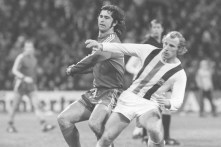
To celebrate this grand union, the three new entrants, Great Britain, Ireland and Denmark played football against the six existing member states: Belgium, France, Italy, Luxembourg, the Netherlands and Germany (well, the bit of Germany not run by the Stasi). The game was held at Wembley; with the West Germans insisting no Russian ran the line.  For the Six (as they were known) there were many players you’d have had in your team up the common – Beckenbauer, Netzer, Gerd Müller and the Dutch player, Neeskens.  The Three had Arsenal, England and Ford Open Prison right back, Peter Storey.

It was fantastic seeing these great players from differing nations playing for two super teams. Of course, we have this today: it is called the Champion’s League. In 1973 this was a massive novelty as we celebrated joining the Common Market.

The year before we’d been celebrating the onset of the three-day week and my school had merged with the school across the rugby field and imaginatively called Bec-Hillcroft before they discovered Ernest Bevin once shopped at Tooting Broadway Market.

I was taken out two-thirds through my 4th year at Bec and sent to Emanuel.  I passed the entrance interview with the headmaster, not because of my academic prowess (I defy anyone who went to Bec to have had as much red biro strewn over their homework) but because the head was drunk and I could successfully juggle three empty bottles of Gordon’s Gin.

Whilst this move in theory was sensible, in practice it was a disaster. What my dad and I had underestimated was the different syllabuses between the two schools.

Having learned every nook, cranny and ox-bow lake along the Rhine Rift Valley, I soon discovered my newly-acquainted fourth-form classmates had been learning about northern America. I knew about Essen, they knew about Eskimos.

I knew every (bloody) word of Pygmalion while my fellow English Lit pupils pranced about the Quad (that’s what they called the playground at Emanuel) pretending they were Lady Macbeth; some of them were quite realistic as they were going through puberty and you never quite knew which octave they’d speak in. Some were handy with a dagger too.

Having done special music at Bec and could hum most of the overture to Weber’s Der Freischutz, my fellow musicians at Emanuel knew every single line to Britten’s A Ceremony of Carols.  I was 121 years behind!

I never bothered with science at Emanuel as giving the answer of “is it a little pip?” to the question “what is a pipette” during my first chemistry lesson, I was destined never to tamper with a Bunsen Burner ever again.

During the exams themselves I remember spending as little time possible in the hall which doubled as the exam room at Emanuel; Ileft most exams after 30 minutes.

I do remember being asked for Music O-level to write a short biography of Federic Chopin. Having swapped schools I was blissfully unaware of him and knew more about Peter Storey.  I liked to think, if he hadn’t got involved with fraud after finishing his football career, he may have written polonaises, etudes of even a three-year (rather than minute) waltz?

So, as we are about to countdown to leave the Common Market we joined in 1973, I’ve no regrets I never continued French O-level at Emanuel.  In two years’ time, if I travel to France, I shall simply speak slower and louder.

So long, farewell, auf Wiedersehen, adieu, as Baron von Trapp, who came on as a substitute for Berti Vogts in that 1973 Three vs Six game, would have said.

Lice, damned lice and steel combs

comb 2

There were, at various stages throughout your school career, times when medical matters loomed on the disinfectant-smelling horizon; although it seemed to go up a gear at secondary school.

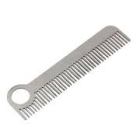
At St Mary’s primary school in Balham I can only remember seeing a nurse a few times – each time armed with a steel comb (these were the days when buzzing combs had yet to be invented) and a glass of disinfectant. After the visit of the nit nurse your hair stank of Dettol and was probably highly flammable until bath night.

Secondary school was like an episode of M.A.S.H. compared with primary school.

In the first year at Bec we had the cough and drop test. I failed.  I was given a card which said “Ascended right testicle”.  I took this home to my mother who knew one of the three words.  I explained to her what this meant.  She was livid.  Not at the fact I’d had an undescended testicle but that I’d not been diagnosed with malnutrition.  I was disturbingly skinny as a kid and was given Virol – a malt extract probably designed by dentists as it was 101% sugar.  Because, as my mother put it, I looked like something out of Treblinka, she was disappointed I’d been told I had something she only knew 33% of.

In the second year we had BCG tests – this was to check if any of us were going to get TB (or consumption if you were examined by an older teacher or the King’s Evil if your school doctor had been reincarnated from medieval Europe). It was also to prevent any of us becoming 20th Century Elizabeth Barrett Brownings – which was unlikely as no one was very good at poetry in my year at school.

The procedure was called the Heaf Test (named after the then PM, Ted Heaf) involved having, what appeared like a multi-staple gun on your arm. It was quite painless.  You waited a week.  If the mark of six spots had gone, you got the BCG injection (and sent to play rugby immediately after); if the mark was still there, you got another note to take home to your parents suggesting a chest x-ray.  Mother was furious, a year on and still no diagnosis of malnutrition.  Plus, Virol wasn’t cheap

We never got tested for Rubella at our all-boys school. I assume, once Brexit is officially triggered on March 29th, Rubella will go back to being called German Measles?

Tooth hurty

dentist

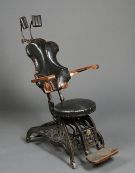
As a kid, I could have easily become either a dentist or a crack addict. The dentist was the preferred option as a child as I’d visit two – one on the corner of Ritherdon and Balham High Road, the other on Crescent Grove facing Clapham Common.  Both were huge houses and, because I was nearly thirty before I physically lived in a house, I wanted to own a massive detached Victorian house when I grew up (toothless or otherwise).

Because my diet was very sugar heavy – you could buy four shrimps and a Jubilee Bag for less than a sixpence and you could raise your cholesterol level in most Balham sweet shops for less than half a crown (the exact monetary value of a portion of big, big carpet-cleaning 1001), my trips to the dentist as a young teenager were more regular than the mandatory six-moth visits. I would (officially) go in April and September. April was chosen as invariably I’d be on school holidays.  One year my mother sent me on my birthday:  Happy Birthday – here’s your present of an amalgam of mercury, copper, tin and zinc – hardly Gold, Frankincense and Myrrh!

Nowadays a drug called Lidocaine (originally invented by a swimming dentist who was a regular at the Tooting Bec Lido) is used for pain prevention, when I went, and you didn’t have gas, the drug was cocaine. It was injected, you didn’t have to bring your own rolled-up ten-shilling note, although, if you did possess a ten-shilling note, imagine how many Jubilee Bags you could buy?  Death by sherbet dab!

The dentist lived on-site with surgeries and waiting room on the ground floor, no doubt above this there were countless rooms filled with recently-extracted rotting teeth. The dentist must have been wealthy living in such palatial splendour, but this, to me raised one question: why were the magazines in the waiting room always out of date?  Before one appointment (in the mid-Sixties) I read, with relief, that Crippen had been apprehended and mother was one year so pleased Mafeking had been relieved.  She knew a Mr Mafeking and wondered if this was something she’d been involved in!

There was always a disappointing selection of magazines, not like the barber’s whose waiting area was stocked with copies of Parade and Health & Efficiency.  It was only when I went to get my haircut that I took such an ardent interest in naturism.  The only chance of sneaking a look at a pair of boobs in the dentist’s waiting room was if they had the 1958 edition of National Geographic which featured ladies from a remote village up the Amazon wearing nothing but a fish-harpoon.

Although I think about it I wouldn’t have wanted to be a dentist – all that halitosis. Plus, you’d never have a decent conversation – unless your patients had the gift of being able to talk with the entire Screw-Fix catalogue in their gobs!  Although I would like to use the word gingivitis at work more.  Gingivitis derives from the fact that St Vitus was ginger.  Open wide.

My padlock’s bigger than yours

padlock

It is ironic, given my most feared lesson at Tooting’s Bec Grammar School, was PE, that I now religiously and willingly attend a gym on a Saturday (Bayern home games permitting) and Sunday (when not serving as an acolyte at the Epsom & Ewell Buddhist Temple for Latter Day Saints).

At Bec we had a PE teacher (for teacher read sadist), Mr Scrowston, who you couldn’t have made up. He didn’t tend to mix with the other teachers and had his own “office” which housed an awful lot of rugby balls, hurdles and shot puts.  There is a line in the film “Hospital” where the star, George C Scott, suggests one of the nurses was trained at Dachau;  I often used to think that Mr Scrowston learned how to teach cross-country running there as he dished those out as punishments.

I could never fully understand why I was so rubbish at PE. I had good hand/eye coordination, but could never climb a rope, jump a buck or successfully execute an angled-head-stand (with or without the aid of my partner).

I recall one moment when Mr Scrowston entered one of the classrooms, prior to us sitting a particularly important geography exam, to tell us the results of the PE tests we’d had the previous week. I and two other class members (out of thirty) had failed to achieve a single point and were therefore punished with a cross-country run at our earliest inconvenience.

In the 4th Year, double history preceded PE.  I would sit in abject fear of what was about to happen in the bowels of the school gymnasium where the surrounding wall-bars I swear had been made from the bones of former pupils who’d also obtained 0% in their PE test.  This innate fear explains why I remember precious little about why Home Rule was considered a good idea by the then PM William Gladstone. Oddly I did remember that Gladstone’s hobby, aside from tree-felling, was rescuing fallen women.  As a very immature and naïve fifteen-year-old, I believed that “fallen women” were clearly women with inner ear problems and that Gladstone was always hovering on the corners of streets near Westminster ready to break the fall of these ill-balanced women.

It wasn’t until I’d read back copies of Parade in Ron and Don’s barbers in Chestnut Grove, Balham that I realised why I’d never make it as a doctor, and certainly never a gynaecologist.

Nowadays there is no one telling me I’m windy, a particular synonym for cowardice in Mr Scrowston’s eyes. During an inter-house cricket match I was facing some particularly hostile bowling and before one ball I had walked towards square leg.  “Richards, you’re windy” announced Mr Scrowston, “cross country run!” – I was automatically given out and sent to run round Wandsworth Common – twice!

The only torment I get at the gym is from 50% of the members who are Chelsea fans and taunt me with memories of the 2012 Champion’s League final. I blame myself as I turn up every weekend with my shirt with number 25 and the name “MÜLLER” on the back.

This week at my gym they introduced a new security system: one involving padlocks. You had to provide your own and it seems that not only does peacocking prevail in the showers (I blame the water being cold, so I don’t take part in that) but now it seems the bigger the padlock the more important you are in the changing rooms.  There are some padlocks which wouldn’t look out of place at Fort Knox.

But not only have you got to remember bringing a padlock, you have to have a sports-related number for the combination.  I have a very good friend at the gym who has decided, as his combination, to have the 1988/89 Chelsea formation (see, there is no escape).  Genius – until Graham Roberts becomes a member of our gym.

I have a small padlock (enter your own gag here) which needs no combination number. Consequently, I now have padlock envy.  I spent an hour jogging, rowing and doing things on the cross-dresser this morning wondering, if I had a padlock with a combination lock, what that number would be?  I decided on 1868, the year Gladstone first became Prime Minister.  Because, whenever I think of Gladstone, I think of doing PE and that is motivation enough.  Although, I look back on my Bec PE lessons and even if I’d have tried trying to vault over a horse, I may have saved time by not needing a vasectomy.