I’ll be dummy

walkman

I started commuting in 1974.

Activities within train carriages have changed somewhat over the decades.

These days everyone is in their own space, their own world, together with their headphones, which are now in all shapes, sizes and colours: they no longer just come in orange foam.

Some like to share their travelling experiences: although I realise I’m never going to be a big fan of rap (also, I’m more Alfie Bass than drum ‘n’ bass).

In 1974 I remember people bought newspapers; I got mine from a man outside Balham Station who called everyone “John” – which was why he was selling papers and not writing for them as his attention to detail was poor.

I’d like to say I’d completed the Times crossword by Stockwell, but this is the boy who struggled on most return journeys with the picture puzzle inside the Evening News.

You can’t smoke in trains anymore, plus the luggage racks aren’t made of rope, thus making Tarzan impressions harder as you can’t swing from one side of the carriage to another.

No longer do I sit on trains where there are bridge schools going on, French tuition being held outside the Buffet carriage or Pilates in First Class.

But the good news is that if you want to play Solitaire, you don’t need the entire table anymore!

People still stare at my Walkman (this isn’t a euphemism).

The eagle hasn’t landed

eagle

Living in Balham in the 60s the chances of being taken by a wild animal was unlikely.

Even when the circus came to Clapham Common, the animal security was quite tight, so you’d have had to have been very unlucky to have been trampled to death by marauding elephants running down Balham Hill.

However, in February 1965, shortly before my 7th birthday, Goldie the eagle (no avian relation to Eddie) escaped from London Zoo.  My dad worked near there, in Gloucester Place, and would go and see the errant bird during his lunchtimes.

My immediate fear of him doing this was: could an eagle carry a five-foot nine man in his beak, thus rendering me 50% of the way to becoming an orphan? And if this happened what sort of work could I do as overnight I’d become head of the household?

As a six-year-old my options were few: chimney sweep was out of the question as we lived in flats; my fear of horses (or any animal larger than a gerbil) preventing the course to becoming a jockey and although Willy Wonka and the Chocolate Factory had been written the year before, casting for the film had yet to begin.

I pondered in my mind that, because dad smoked about 40 Senior Service most days, would the eagle pass on capturing my dad as the eagles could be more partial to filtered fags or even Consulate?

My fears were abated twelve days’ later as the eagle was recaptured – dead mice being preferable to 20 Kensitas.

Security was enhanced at London Zoo shortly after that as Pipaluk never escaped.

Sofa so good

sofa

Hiding from the TV detector van was easy if you lived on the fourth floor of a block of flats. I had surmised that the van would not only have never get through the revolving doors at the entrance to my Balham flats, but also, it’d never get inside the lift as the antennae would probably snap off.

There was no warning of the van’s impending arrival – no theme tune from Jaws/Psycho/or the little known Confessions of a TV Detector Van Cleaner.

I’m sure people (whose dwellings were at street level) would hide behind their sofas, a plethora of Habitat scatter cushions or a life-sized cardboard cut-out of a TV detector van – to ward it off like an evil spirit.

This, of course, would be the antithesis of being out by leaving the radio on, thus giving the impression (especially to potential burglars) that someone was actually in.   This stems from the urban myth that burglars have a pathological fear of The Archers, the long-range shipping forecast or stumbling into a house at a time when Sing Something Simple was on.

But sometimes there are programmes on when you want to hide behind the sofa – if there are too many such programmes broadcast on the BBC, could you apply for a rebate?


un petit pas

clangers

I blame Neil Armstrong for me not being fluent in French.

On 16th July 1969, towards the end of my first year at my Tooting grammar school, a TV was hurriedly bundled into the classroom during a French lesson, for us to watch the Moon landing.

I welcomed any excuse to miss French and would have been happier watching an old episode of The Clangers (which inspired space travel) in preference to conjugating verbs like Avoir, être or faire la grève (a popular verb in late 1960s France).

I look back fifty-years and wonder if Neil Armstrong (whose cameo in Hello, Dolly I particularly enjoyed) regrets not taking a golf club like one of his successors?  I’m not a trained astronaut, but given the choice of essential items between a six-iron and more oxygen, I’d opt for more breathable air!

Despite being a frequent flyer, I probably wouldn’t make it as an astronaut; during any hint of turbulence, I’m grabbing the stranger next to me’s arm as if I were a human tourniquet. So, going at 6,164 mph, as the Saturn 5 rocket did, wouldn’t appeal – unless Buzz Aldrin wanted his blood supply cut off.

I’ve never walked on the Moon (unlike Neil Armstrong and Sting), and I still don’t know the past participle of the verb atterrir!

Yours sincerely

Clair de Lune


Much bindweed in the marsh

bindweed

It’s that time of year when private gardens are opened up to the more green-fingered public.

Having lived during the 60s and 70s in various south London flats until the age of 25, I never had a garden of my own. And living on the fourth floor, unless I’d been Red Adair, a window box would have been spectacularly dangerous.  So, the decision of having some finely-cultivated begonias combined with plummeting to an early death versus life was quite a simple one to make.

But this lack of horticultural knowledge means the gardens I have owned are highly unlikely to be opened to the public – unless the RHS introduces “Best in class bindweed” at the Chelsea Flower Show.

As a teenager I did buy the I-Spy book of clematis, but, due to lack of spelling ability, was sadly disappointed.  I watched Bill and Ben avidly for gardening tips.

At primary school we were given bulbs to plant; the success I had I might as well have planted one from Philips – such was the greater chance of growth!

I’d love to write into Gardeners’ Question Time and ask: “I think I have Japanese Knotweed; can the panel recommend a good ointment?”

As far as I’m concerned nettles is the bloke who played Bergerac!

Holding a candle for the dustman

candle

If I’d been an entrepreneurial thirteen-year-old in December 1970, I should have been buying and selling candles from the bedroom of my Balham flat.  If there’d been a queue, the punters could have occupied themselves in the next-door bathroom with my model of Stingray and fleet of plastic U-Boats.

During the “winter of discontent”, fuel supplies were low, and Ted Heath warned of power cuts.

(I knew it was Ted Heath speaking to the nation on the TV and not Hughie Green (who was normally on the telly) as he never said the word “sincerely”).

Each day I’d be sent to fetch a copy of the Evening Standard as they published when SW17 was going to be plunged into darkness.

Because my block of flats was quite labyrinthine, once the lights went out, the corridors became a black abyss. If you were an early teenager this was tremendously exciting, but then, when you realised you were completely lost, there was the overriding sense that you really should have eaten more carrots when younger.

These were the days before scented candles. There wasn’t the chance, during these blackouts, to have your flat suddenly smelling of Fresh Linen, Jasmin or Schnitzel with Noodles. There was one sort – the types you get in churches, only smaller; a strong relationship with the local ironmonger was key (or knowledge of someone who had moved on from stealing church roof lead).

If you’d asked anyone in December 1970 what Yankee Candle was, most people would have thought it was a film with James Cagney in.

Tide up

washing

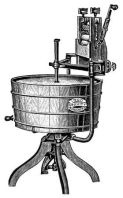
I was never a dirty kid growing up, but the moment I discovered you got free plastic soldiers in packets of Tide, I became a mudlark overnight.

I would seek out dirt and puddles round the back of my Balham block of flats to increase the necessity of clothes washing: therefore, more soldiers.

My desire was to create my own Terracotta army (only in plastic – and slightly shorter).

Looking back, my mum could have taken in a year’s washing for the entire SW17 postal district and I’d have still come up short of the 8,000 soldiers which the aforementioned army comprises.   That’s a lot of Tide.  As Balham’s not in a monsoon area, we would never have had enough puddles.

Growing up in the 60s there were often things inside grocery packets – PG Tips and their cards being an obvious example – cereal packets would have toys inside too (small, blue, twisted packets of salt weren’t toys by the way), but this seems to be a thing of the past.  My journeys accompanying my mum to the supermarkets on Balham High Road would always be governed by my desire to buy products with free items inside – never mind the quality, feel the gift!

Washing powder has now mainly been replaced by washing liquid – the last thing you want to be doing is fishing out a soldier covered in a viscous cleansing agent; it’d make a mess of your fort for a start!

And if I’d been challenged on my doorstep – I’d have always taken two packets of Tide.

Sushi and the Bandit biscuits

red rover

Contents of a Tupperware box have changed over the years.

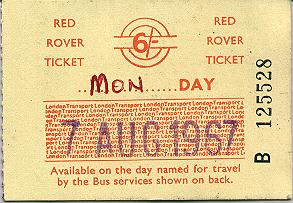
During summer holidays in the 60s and 70s I’d purchase my Red Rover ticket at Balham Underground Station and travel as far as possible, believing Ongar was not only (then) the end of the Central Line, but also that beyond that, you’d drop off the end of the Earth.

With me would be my Tupperware box full of 60s/70s foodstuffs: Spangles; Blue Riband biscuit; a meat-paste sandwich consisting more paste than meat and another Tupperware receptacle holding water with just a hint of squash (as the combination of e-numbers, the depths of the Northern Line and 80% of all Spangles eaten by Clapham North may have had a detrimental effect on mummy’s little Mickey Mouse’s tummy).

These days the Blue Riband would be replaced by something which is now 90% cashew (even though it is called “chocolate something” on the wrapper); water will be the only drink – preferably flown in from a mountain stream feeding Lake Geneva; Spangles replaced by the most exotic fruit from an island which hadn’t even been discovered in the 60s and all forms of bread would have been replaced by sushi.

In the 60s Sushi was likely to be the name of someone who worked alongside Steve Zodiac, Troy Tempest or Captain Scarlet.


Water, water, not quite everywhere

horse trough

These days no one is more than six-feet away from a bottle of water; the summer signs at Tube stations actively encourage you to carry one. So how come none of us living in London in the 60s and 70s died of dehydration?

Growing up I’d play outside for hours, either trying to become the next Alan Knott or Gerd Müller; but I’d never have any form of liquid near me. I’d return to my Balham flat and be given orange squash diluted by tepid (at best) water from the tap, not some chilled bottle of Perrier or Evian.

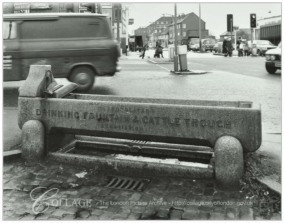
I always judged people as being posh if I was ever invited anywhere for tea and offered lemon squash. We never had fruit juice either (how I never contracted scurvy I’ll never know!) and the Du Cane Fruiters opposite my Balham flat never sold anything from outside the UK (they were advocating leaving the EU before we even joined in 1973), so the only fruit intake I had was at half-time during school football matches.  Accessible water, unless you were having it flown in from the Perrier factory in the Gard departement in France, was restricted round my way to the school water fountain or the horse trough on Mitcham High Street.

These days water bottles proliferate and the substances inside manifold. But, if you’d have asked me in the mid-60s, after running around Wandsworth Common like a banshee, if I’d have liked an Elderberry Press, I’d have assumed it was the name of a local newspaper!

Going Virol

virol

There are many smells from my youth growing up in the 60s & 70s, which have stuck with me and ones I fear may never smell again.

Last week I talked of applying calamine lotion on anything burning during a childhood ailment and, if you’d suffered, one smell you’d never remove from your olfactory sense.

Virol too, is a smell I’ll never encounter again, as people now know obesity is not the name of an Afrobeat band from the 70s. Virol was a malt extract (made of 200% sugar) which you were given as a kid if you were skinny; I was like a character in an LS Lowry painting and got given it by the vat load!

Excessive use of chlorine is another long-forgotten smell. Due to an altercation with a swimming instructor aged eight (I was eight, the swimming instructor wasn’t, as that would have been dangerous, unless they were half-haddock) I didn’t swim much, but, am aware chlorine in swimming baths has subsequently been watered down – although the faintest of smells bring on my hydrophobia (I don’t foam at the mouth as much these days).

Burnt milk is another (courtesy of Costa, Starbucks etc.) waft you don’t get.  Before any Seattle-based coffee shop entered the UK, my nan would boil up milk for a “frothy coffee” is her saucepan.  Invariably she’d forget, having gone off in pursuit of a Player’s Weight, whilst the milk, originally destined to become a frothy coffee, was fast becoming more like the top of a crème brûlée!

I can only think the need for lepidopterology is rapidly declining as, whenever you used to visit an aging relative, you were hit by the overriding smell of mothballs. Perhaps moths are now on coat-free diets?