Flowers in the train

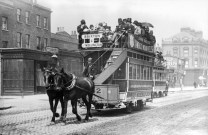
tram

One week back in Covent Garden, after nearly four decades away, I have discovered they’ve moved the London Transport Museum from Clapham.

As kids in the 60s we would walk the along the A24 (probably a Roman Road which linked Watling Street to Offa’s Dyke via Gaul) from my flat in Balham to the huge hangar which housed more trams than you can shake a stick at just past Clapham Common Station.   We walked, as this saved on the bus fare, plus we wanted to feel like Centurions.

No one was especially interested in 19th Century Tube trains, but it made a change from going to South Ken to see a blue whale, a dodo and a couple of coelacanths.

Also, in Covent Garden, there seem to be nicer shops than when I was last here. Indeed, the office where I was is now a Gap store.  When I’d worked there previously the only gap was in the window next to where I sat giving me the impression of feeling like Bert Trautmann for my eighteen months tenure in WC2.

One thing I have seen is a lot of men in black jackets carrying square-shaped brief cases – presumably they are carrying portable chess boards – there are a few who look like Bobby Fischer, although with handshakes that they’re giving out, would struggle to move any chess pieces!

Because of the theatres round here I’ve already seen various celebrities – yesterday I saw Mark Thatcher – I assume he’s in The Lion King? I guess it’s just a matter of time before I see Eliza Doolittle?

Perpetual balls

drinking bird

Last Monday I moved offices and pondered how the contents of my desk differed to that of my first desk, which was situated just off the Strand in 1974 (in an office building, obviously, not me sat, on the Strand, at a desk outside the Stanley Gibbons shop).

The fundamental change on my desk being there is a PC now and no sign of a Newton’s Cradle (certainly no drinking bird with its nodding head slowly filling up with (in my case) Civil Service tea) – a must for any executive desk (not that I was anything like an executive in 1974).

I did have a typewriter – for younger readers this was like a PC, only with slightly more dexterity needed to type, although it did come with a selection (red and black) of typewriter ribbons; sadly, it didn’t have Tetris.

As well as the example of conserving momentum and energy (who said physics was useless at school?), aside from Newton’s Cradles being on desks, during the 70s, there would always be some form of calendar involving wooden blocks; and if you really were an executive, an angle-poised lamp.

The most senior person in the room would possess the pencil sharpener – scarily not dissimilar to ones you’d have had at primary school, so talking to your boss always left with you the feeling that you’d hope you’d not be tested on your four times table.

But no executive desk was complete without having some form of balancing toy. The trick was to tap the toy and set off the perpetual motion without being too cack-handed and knock it off.  It would be the nearest any of us got to doing gymnastics.

Tomorrow I’m off round the shops in Covent Garden to seek out a 70s executive toy. I wonder if the drinking bird likes Irn Bru?

Michael Miles High Club

400px-Takeyourpick_gong_yesnogame

I miss “Take Your Pick” not being on on a Friday evening. I would sit with my nan in her Balham flat urging everyone to fail at every opportunity.

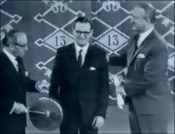
The first hurdle for the contestants was the yes/no interlude, when questions would be asked where the obvious Pavlovian response would have been yes or no. “Is the Pope Catholic?” being one of Michael Miles’ trickier questions.  If, after the longest minute of their life to date, the contestant had successfully avoided saying neither yes nor no, they’d be given five bob (25p in new money).  Five bob was double my pocket money in the sixties when Take Your Pick was aired and I believed that five bob could probably have bought the universe – certainly could have bought Rediffusion, the programme’s producers.

If the contestant failed, their ignominy was doubled by having former Pathé News newsreader, Bob Danvers-Walker, banging a gong next to them to make their ears bleed.

I especially enjoyed the climax of the show when the contestants could potentially win a booby prize. The use of the word booby on TV before 9.00 pm amused me.  I was only 11, I hasten to add.

During the show the contestants would have accumulated money and were faced with the ultimate choice of betting against their current winnings (take your pick – geddit?) – on offer by selecting “Box 13” – this could have been a holiday in Totnes, or something equally exotic or an aforementioned booby prize, like a mousetrap. It was when the word stress was first invented.

My nan and I would hope people would select “Box 13”; very few people did; no bad thing as some weeks inside was a three-headed dog who guarded the gates of Hell. Marginally worse than going to Totnes.


Ex-directories

telephone seat

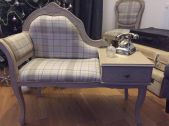
There must be a massive market for old telephone seats?

With the advent of modern phones there are several pieces of unwanted furniture no longer needed; the old-fashioned telephone seat, much loved in the 50s, 60s and 70s, is sadly one – along with locks on the phone, wires and telephone directories.

In London there were the four monster books; when they’d arrive you’d always check your own entry and then see if there were any rude names to ring. I was always disappointed to find there was no Mr Knob living within the London postal district.  They were great door-stops, but not very good if your telephone seat was bit wobbly at one end.

I was never encouraged to sit too long on the telephone seat as my mother told me this was how you got piles. Piles of what I always thought to myself not having been professionally trained in rectology?

But there was something even more dangerous than falling off an unbalanced seat or haemorrhoids: that was the address book – not a simple one you’d add people whom you’d met on holiday and would swap Christmas cards with for a respectable period of time until you realised that Hayling Island was a long way from London and did you really liked them? – the device with the letters down the side, which, when pressed, opened up at a speed like that of a hunting cheetah.  If you had bad eye-sight, like me, you’d need to be close to check the number you were about to ring – consequently there was always the danger of just prior to making a call, you’d re-enacted the most famous bit of the Battle of Hastings.

I often dreamed of being able to rip a London telephone directory in two. I clearly never followed the instruction manual which came with my Bullworker that accurately.

Rings a bell

telephone

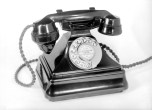
You no longer have to answer phones with your number.   Somehow reciting the words “Balham 0557” still rings (no pun intended) favourably with me and was gutted when, sometime in the 60s, the Balham prefix BAL changed to the very impersonal 673 – where is the magic with that?  At least make it 666 – infinitely more comedic; the telephone exchange number of the Beast!

I had an aunt who had a phone voice; if you rang her she started off as Princess Margaret and if she knew who you were would instantly (subsequently moving several rungs down the ascendancy to the Throne scale) became Margaret Powell (who might have driven a Princess, but certainly wasn’t one).

My family’s first phone was red and was a step up from the yoghurt pots and string we’d owned before; although more expensive, you never got cross lines on a yoghurt pot and there were no party lines either – it was YOUR yoghurt pot – no waiting for the old woman downstairs to come off the phone to the chimney sweep.

Until Trimphones came along phones were quite cumbersome – only slightly smaller than the Colossus built at Bletchley Park.   The receivers were good, however, if you wanted to practice rounders in your lounge.

Phone boxes aren’t as popular as they were, either. No wonder there are loads of ads on TV for printing your own business card, the former major advertisers within phone boxes now (allegedly) use the Internet.  And pressing “Button B to get your money back” was how fruit machine addiction began.

“Putting you through now, caller.”

The postman doesn’t even ring once!

postcard

Around this time of year, when I was growing up in London in the 60s and 70s, I’d anticipate copious amounts of postcards from friends and relatives arriving showing pictures of a place within the town they were staying where they’d never visit, but locally it was iconic, and/or telling me they wished I was there (which begs the question: why wasn’t I invited in the first place?)

Cards would come from far-reaching places such as Bognor, Bournemouth, Bideford – having been brought up in Balham it seemed that my friends and relatives were incapable of travelling anywhere which didn’t begin with a “B”. (These days people will travel to Belize, Bolivia, Bogota – nice, but do they do a nice cream tea there?)

No one sends postcards anymore; instead of “wish you were here” on the back of a card featuring a beach, historical monument or a cartoon of a large-breasted woman berating her diminutive husband with an innuendo like “why can’t your sand castle be that big?” you get a text or an email which says: “arrived safely”, swiftly followed by over a hundred Instagram photos of the baggage retrieval area of some distant airport and bemoaning the fact that why is it so few people speak English in the Belgian Congo?

One of the last postcards I sent was in 1973, around this time of year, wishing that my mum and dad were here and hoping I’d done well in my O-levels.  I hadn’t; the punishment being the next year with two weeks in Benidorm – also beginning with B – like Bubonica Pestis (a little-known Greek island).

Spud-U-Dislike

sekiden 2

I’ve never touched an actual gun, courtesy of there having been no second amendment in the 1904 Balham Constitutional Club founding declaration.

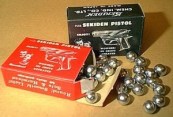
As a kid, however, to protect myself from strangers and head of my one-man vigilante group, I did possess a Sekiden gun. I also owned fifty silver balls (these were the Sekiden gun’s ammunition not something I’d miraculously acquired during one of my many hernia operations).

Before you could progress to owning a Sekiden gun, you’d have to prove your responsibility with a spud gun (it is an apocryphal thought that the 1845 Irish Famine was caused by the over-use of spud guns within the Emerald Isle).

Armed with my spud gun and a couple of potatoes past their sell-by date courtesy of the Du Cane Fruiters, I would stalk my south London flats seeking out the cleaners – their sole protection being a mop, set of rubber gloves and a tin of Duraglit. Luckily for them my aim was less Jack Ruby more Ruby Murray.

Balham was a gun-free zone as far as I knew growing up in the 60s and the biggest chance of dying was of embarrassment if you’d had your jeans bought for you from the local Tesco Home ‘n’ Wear.

…with my little, pre-adolescent eye…

ispy

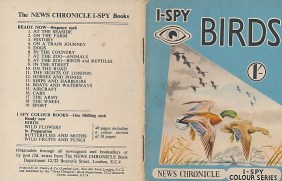
I always fancied being Big Chief I-Spy as I collected several of the pocket-sized books he began publishing from his office in Bouverie Street, throughout the 50s and 60s.

Because I rarely travelled outside the SW17 postcode as a child, books like I-Spy On The Farm; I-Spy At The Zoo and I-Spy Country Crafts remained largely empty.  Although I did once make my own entry of 100 points for spotting a Woolly Mammoth on an imaginary farm.

I nearly completed I-Spy In The Street – spotting a Belisha Beacon; a Zebra Crossing and, if you took your A6 book out at night and walked up Bedford Hill in Balham, you’d get fifty points for spying “a lady of the night”.

The most marks you could get in I-Spy On The Train was ticking off a severed head which’d been poked too far out of a window you used to be able to pull down.

In 2011 new editions were launched to bring the series more up-to-date: I-Spy On A Car Journey In France being one.  Within this the top points were: seeing the suspension go on a car carrying far too much cheap, Beaujolais; a French policeman nicking the car in front just because it had GB stickers on and General de Gaulle saying “Non!” (all a bit academic after Brexit).

The idea was actually first thought of in the seventeenth century with I-Spy At The Public Execution, where you were encouraged to look out for a basket (extra points if it contained a head); an axe and a woman with no teeth, knitting and swearing at the same time.

Keep ‘em peeled, as Big Chief I-Spy would say *

*With apologies to Shaw Taylor

Re: cycling

scooter

Unless I’d suddenly acquired a shocking sense of direction, after being given a new bike, living on the 4th floor of a block of flats, may have been life threatening.

However, I never owned a bike (new, old or jet-propelled in case of emergencies). My parents clearly realised that turning right from our lounge would have led me to become more lemming than Lance.

Because of my devotion to Twix, Lycra is not my clothing of choice.  Although, men of my age in their droves are switching to cycling from playing golf.  However, I’m better off holding a putter rather than looking like I’d had one shoved down my Lycra shorts (especially in cold weather).

In the 60s, growing up in south London, few people had bikes, going everywhere by “Shank’s Pony”; which I realised, later on in life, didn’t mean they owned horses.

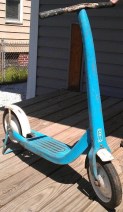
I did have a bright blue scooter and was allowed to propel myself (supervised) around Wandsworth and Tooting Bec Commons. This may be why I have one quadricep bigger than the other as I never mastered changing legs.  (I became very proficient at accelerating past The Priory on Tooting Bec Common as that was very menacing).

There were no cycle lanes back then – no need as there were fewer cars. The only markings on the roads were hop-scotch grids – and the occasional chalk outline of a man on Balham High Road – I assume this was some prehistoric cave painting, like the Cerne Abbas Giant – he’d have certainly looked good in Lycra.

I always wanted a Chopper – but that’s perhaps a question for my gynaecologist?

A-roving, a-roving

paste

There was a time when you could travel from Balham (if you lived there) to (almost) the outer limits of the Universe (as long as a London Transport bus went there) for only ten bob.

A Red Rover was a frequent purchase for me and my mates in the late 60s, early 70s; a time when we were young teenagers and had irresponsible parents who’d cast us onto the streets, armed only with ten shillings, a Tupperware cup full of Coke and or milk (depending on how nauseous you wanted to get), a Penguin and a selection of (one) sandwiches made with the pride of the Shippam’s factory.   Travelling from Balham, most of our packed lunches had been consumed by Clapham North.

I had a paternal aunt and two cousins who lived in North Harrow (which, when looking at the bus map at Balham Underground Station, might have been outside the Universe, let alone at its furthest boundary). I decided we should take a selection of ostensibly twenty buses and go and visit my dad’s remote family.  It seemingly took several weeks but, having successfully arrived, starving by this point as we’d mistimed our food intake (which is why none of us joined the Commandoes), we discovered they were out.  No mobile phones those days to say: “Hi, Auntie Betty, we’re coming to visit”, not even a couple of old yoghurt pots to communicate our impending arrival.  So, skint, hungry and tired we ventured back to south London with my friends assuming this extended family didn’t exist.

I go nowhere these days without the aforementioned yoghurt pots (in case of emergencies) and always have a ten-shilling note hidden inside the secret heel of my shoe – the one next to the beaver footprint.