Much bindweed in the marsh

bindweed

It’s that time of year when private gardens are opened up to the more green-fingered public.

Having lived during the 60s and 70s in various south London flats until the age of 25, I never had a garden of my own. And living on the fourth floor, unless I’d been Red Adair, a window box would have been spectacularly dangerous.  So, the decision of having some finely-cultivated begonias combined with plummeting to an early death versus life was quite a simple one to make.

But this lack of horticultural knowledge means the gardens I have owned are highly unlikely to be opened to the public – unless the RHS introduces “Best in class bindweed” at the Chelsea Flower Show.

As a teenager I did buy the I-Spy book of clematis, but, due to lack of spelling ability, was sadly disappointed.  I watched Bill and Ben avidly for gardening tips.

At primary school we were given bulbs to plant; the success I had I might as well have planted one from Philips – such was the greater chance of growth!

I’d love to write into Gardeners’ Question Time and ask: “I think I have Japanese Knotweed; can the panel recommend a good ointment?”

As far as I’m concerned nettles is the bloke who played Bergerac!

Holding a candle for the dustman

candle

If I’d been an entrepreneurial thirteen-year-old in December 1970, I should have been buying and selling candles from the bedroom of my Balham flat.  If there’d been a queue, the punters could have occupied themselves in the next-door bathroom with my model of Stingray and fleet of plastic U-Boats.

During the “winter of discontent”, fuel supplies were low, and Ted Heath warned of power cuts.

(I knew it was Ted Heath speaking to the nation on the TV and not Hughie Green (who was normally on the telly) as he never said the word “sincerely”).

Each day I’d be sent to fetch a copy of the Evening Standard as they published when SW17 was going to be plunged into darkness.

Because my block of flats was quite labyrinthine, once the lights went out, the corridors became a black abyss. If you were an early teenager this was tremendously exciting, but then, when you realised you were completely lost, there was the overriding sense that you really should have eaten more carrots when younger.

These were the days before scented candles. There wasn’t the chance, during these blackouts, to have your flat suddenly smelling of Fresh Linen, Jasmin or Schnitzel with Noodles. There was one sort – the types you get in churches, only smaller; a strong relationship with the local ironmonger was key (or knowledge of someone who had moved on from stealing church roof lead).

If you’d asked anyone in December 1970 what Yankee Candle was, most people would have thought it was a film with James Cagney in.

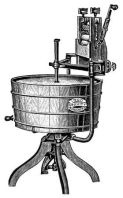
Tide up

washing

I was never a dirty kid growing up, but the moment I discovered you got free plastic soldiers in packets of Tide, I became a mudlark overnight.

I would seek out dirt and puddles round the back of my Balham block of flats to increase the necessity of clothes washing: therefore, more soldiers.

My desire was to create my own Terracotta army (only in plastic – and slightly shorter).

Looking back, my mum could have taken in a year’s washing for the entire SW17 postal district and I’d have still come up short of the 8,000 soldiers which the aforementioned army comprises.   That’s a lot of Tide.  As Balham’s not in a monsoon area, we would never have had enough puddles.

Growing up in the 60s there were often things inside grocery packets – PG Tips and their cards being an obvious example – cereal packets would have toys inside too (small, blue, twisted packets of salt weren’t toys by the way), but this seems to be a thing of the past.  My journeys accompanying my mum to the supermarkets on Balham High Road would always be governed by my desire to buy products with free items inside – never mind the quality, feel the gift!

Washing powder has now mainly been replaced by washing liquid – the last thing you want to be doing is fishing out a soldier covered in a viscous cleansing agent; it’d make a mess of your fort for a start!

And if I’d been challenged on my doorstep – I’d have always taken two packets of Tide.

Sushi and the Bandit biscuits

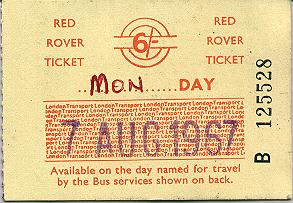
red rover

Contents of a Tupperware box have changed over the years.

During summer holidays in the 60s and 70s I’d purchase my Red Rover ticket at Balham Underground Station and travel as far as possible, believing Ongar was not only (then) the end of the Central Line, but also that beyond that, you’d drop off the end of the Earth.

With me would be my Tupperware box full of 60s/70s foodstuffs: Spangles; Blue Riband biscuit; a meat-paste sandwich consisting more paste than meat and another Tupperware receptacle holding water with just a hint of squash (as the combination of e-numbers, the depths of the Northern Line and 80% of all Spangles eaten by Clapham North may have had a detrimental effect on mummy’s little Mickey Mouse’s tummy).

These days the Blue Riband would be replaced by something which is now 90% cashew (even though it is called “chocolate something” on the wrapper); water will be the only drink – preferably flown in from a mountain stream feeding Lake Geneva; Spangles replaced by the most exotic fruit from an island which hadn’t even been discovered in the 60s and all forms of bread would have been replaced by sushi.

In the 60s Sushi was likely to be the name of someone who worked alongside Steve Zodiac, Troy Tempest or Captain Scarlet.


Water, water, not quite everywhere

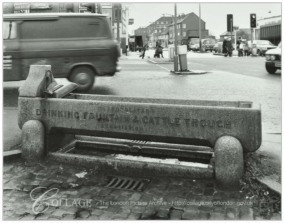
horse trough

These days no one is more than six-feet away from a bottle of water; the summer signs at Tube stations actively encourage you to carry one. So how come none of us living in London in the 60s and 70s died of dehydration?

Growing up I’d play outside for hours, either trying to become the next Alan Knott or Gerd Müller; but I’d never have any form of liquid near me. I’d return to my Balham flat and be given orange squash diluted by tepid (at best) water from the tap, not some chilled bottle of Perrier or Evian.

I always judged people as being posh if I was ever invited anywhere for tea and offered lemon squash. We never had fruit juice either (how I never contracted scurvy I’ll never know!) and the Du Cane Fruiters opposite my Balham flat never sold anything from outside the UK (they were advocating leaving the EU before we even joined in 1973), so the only fruit intake I had was at half-time during school football matches.  Accessible water, unless you were having it flown in from the Perrier factory in the Gard departement in France, was restricted round my way to the school water fountain or the horse trough on Mitcham High Street.

These days water bottles proliferate and the substances inside manifold. But, if you’d have asked me in the mid-60s, after running around Wandsworth Common like a banshee, if I’d have liked an Elderberry Press, I’d have assumed it was the name of a local newspaper!

Going Virol

virol

There are many smells from my youth growing up in the 60s & 70s, which have stuck with me and ones I fear may never smell again.

Last week I talked of applying calamine lotion on anything burning during a childhood ailment and, if you’d suffered, one smell you’d never remove from your olfactory sense.

Virol too, is a smell I’ll never encounter again, as people now know obesity is not the name of an Afrobeat band from the 70s. Virol was a malt extract (made of 200% sugar) which you were given as a kid if you were skinny; I was like a character in an LS Lowry painting and got given it by the vat load!

Excessive use of chlorine is another long-forgotten smell. Due to an altercation with a swimming instructor aged eight (I was eight, the swimming instructor wasn’t, as that would have been dangerous, unless they were half-haddock) I didn’t swim much, but, am aware chlorine in swimming baths has subsequently been watered down – although the faintest of smells bring on my hydrophobia (I don’t foam at the mouth as much these days).

Burnt milk is another (courtesy of Costa, Starbucks etc.) waft you don’t get.  Before any Seattle-based coffee shop entered the UK, my nan would boil up milk for a “frothy coffee” is her saucepan.  Invariably she’d forget, having gone off in pursuit of a Player’s Weight, whilst the milk, originally destined to become a frothy coffee, was fast becoming more like the top of a crème brûlée!

I can only think the need for lepidopterology is rapidly declining as, whenever you used to visit an aging relative, you were hit by the overriding smell of mothballs. Perhaps moths are now on coat-free diets?

Chocolate is not just for Easter

easter

Living on the fourth floor of a block of flats meant Easter egg hunts were precarious to say the least.   My mother was good at hiding them, but I never felt confident with her scaffolding-erecting skills outside the lounge window.

In the 60s I’d get Easter eggs from benevolent relatives. They’d be from Cadbury’s and would contain (inside) a small packet of chocolate buttons – as if you’d not had enough chocolate with the actual egg!

Nowadays you can spend hundreds of pounds in Hotel Chocolat (who can’t even spell chocolate) or from Lindt (which, when I was growing up, was something you’d put on a wound).

Creme (what is it with the inability to spell correctly in the confectionary industry?) Eggs were introduced in the UK in 1963, the same year there was a rise in anti-emetic drugs.

I believe there is something in Easter eggs which make them even more addictive than normal chocolate. It clearly isn’t just the sugar.  Perhaps there is crack cocaine inside?  I’d be very unhappy if I were to get an Easter egg where a Curly Wurly had been replaced by some Class A drugs.

Although it might explain the ads with Terry Scott in in the 70s.

Happy Easter!

Go to Jail

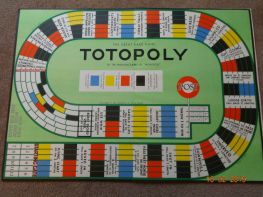
totopoly

Easter holidays have kicked in and with it the need to entertain kids/grandkids/aged aunts.

Do the kids of today play board games like Monopoly (slightly out-dated as you can’t get a packet of crisps for £400 in Mayfair, let alone build a hotel there)?  Or Totopoly (before Ray Winston demanded you gamble responsibly and where Old Kent Road was replaced by Arkle) Or Go – the international travel game (a typical game now takes several years due to the USSR now being fifteen different countries, Yugoslavia is spilt (no pun intended) and Czechoslovakia’s never been the same after Jim Prideaux was brought back)?

Today there is X-Box (like Pandora’s box only containing more of the world’s ills); Minecraft (a 1957 hit for Frank Sinatra) and anything by Nintendo (easily my favourite 70s wrestler).

Kids of today probably believe rolling a dice might dislocate their wrists; the thought of taking on the persona of an old boot for a couple of hours would seem abhorrent if they’ve never had anything second-hand and playing with pretend paper money is something they’d expect to see on Antiques Roadshow as surely everything is contactless?

They are unlikely to know what a billiard room is, let alone knowing what a candlestick might be used for – and (literally), Heaven forbid the local vicar’s a murderer!

We might have to wait a long time before we see Grand Theft Top Hat

Tubs, tubs, tubs

usherette bag

In 1970, me and three others were in the Granada Tooting, a cinema built in 1931 to accommodate 4,000 people.   I was watching Tora, Tora, Tora, a film about the attack on Pearl Harbour.  The cinema was therefore 0.1% full.

With me there were my dad, a friend of my dad’s and the usherette. There was a fifth, but he didn’t count, as he was the projectionist – he had to be there; the usherette didn’t – tubs were quite expensive and it wasn’t until my mid-twenties that I realised I didn’t have an allergic reaction to raspberry ripple as my dad had suggested when I was younger.

The Granada Tooting closed, as a cinema, in 1973. With dwindling cinema goers and over-priced wafers, they had committed their own economic and cinematic Kamikaze.

Also, there was no atmosphere, unlike when I went to see Jaws at the Ruby, Clapham Junction (another cinema also sadly playing in the great picture house foyer in the sky).

It had been raining heavily during this 1975 winter’s evening as I trudged across Wandsworth Common to get to the cinema; I was glad of the protection once inside the Ruby. Sadly, the Ruby had seen better times and, due to the excessive rain, had sprung a leak in its roof.  A consequence of this is was, as I watched the film, it felt as if I was on the boat with Messrs Scheider, Dreyfuss and Shaw, as I became increasingly wet.

It was like being there except they weren’t holding a Kia Ora on the boat and nor did they develop trench-foot a week later!

Plus the passive-aggressive usherettes in the Ruby were scarier than any Great White Shark!

…and Charley’s your aunt

cottingley-fairies_1466870c

I was often confused as a kid as both parents and grandparents would tell me things which, with the small knowledge I’ve gathered over sixty-plus years, were either horribly inaccurate or a total lie.

If ever I made a face (which tended to happen if my nan was cooking boiled fish in parsley sauce – a concoction which should be considered as an alternative to anthrax in biological warfare) she would say “if the wind changes, you’ll stay like that”.  The UK is situated in the path of a polar front jet stream – winds are frequent, facial disfigurements for me fortuitously weren’t.

My mum would use the word bleedin’ so much, growing up I realised that an urgent learning of the rudiments of First Aid was going to be a must.  Luckily, however, it seemed there was nothing inside our flat which was haemophiliac.

Bob’s your uncle was recited many times.  I never met Bob – even with much genealogical research.  My mum would “entertain” many people – several had the epithet “uncle” – in our flat, but none featured on my home-made family tree chart, even fewer called Bob!

And as for fairies being at the bottom of my garden: living in a fourth-floor flat, unless you can get apparitions amongst your begonias in your window boxes, there was never going to be a Fatima-like vision which I was perpetually promised.

And the word wireless these days doesn’t necessarily have to involve Lord Haw-Haw.