It’s in the jeans

nun

I’ve never owned a pair of blue, denim jeans.

I’m probably in that 0.01% of the world’s population where a pair has never been in my wardrobe, but I was never realistically given the option.

Rather than spend money on a pair of Levi’s or Wrangler’s, the only option to me was the Tesco Home ‘n’ Wear on Balham High Road.

As a teenager in the early 70s, I earned no money, so was reliant on my mother as my clothing benefactor. This benevolence sadly only stretched the 500-yards from our flats on Balham High Road to the non-food Tesco shop further down the road – not for me anything from Reno, Nevada or Greensboro, North Carolina!  Tesco Home ‘n’ Wear, Balham was the only choice.  A consequence of this non-option was that I never owned a pair of blue denims from a famous brand.  The only thing shrinking in my bath as a teenager might have been blue, but certainly wasn’t made out of denim.

The same fate struck me with shirts. I so wanted a Ben Sherman shirt; the option I was given was one from Trutex (might as well have been Artex – arguably more fashionable and at least I could have covered my ceiling with it).

Trutex was to Ben Sherman what Hot Hits and Top of the Pops records were to the songs’ original artists.  Similar, but the collar, designed like the hat on The Flying Nun, gave it away that it was not the real thing!

I’ve never been that fashion conscious – probably scarred by the disastrous Haute Couture forced on me as an adolescent.  To me, as a teenager, a Kaftan was a dog known for its long, shiny hair; flares were things you activated if marooned at sea and (until Eurotrash was aired on Channel 4) I thought Jean-Paul Gaultier was the best full back Paris Saint Germain ever had.


An imaginary bunny is not just for Easter

old-pliers-stock-picture-3428613

I first encountered the Tooth Fairy in 1961.

I never actually met her (or him) (and assumed they lived in my Balham block of flats as you wouldn’t have wanted to walk down the High Street in the middle of the night) but was told that he/she or it carried sixpences to replace missing teeth. I worked out, in a JP Morgan-type of way, that I could stand (or lie, as I was invariably in bed when the Tooth Fairy visited) to eventually gain ten-bob, as I had twenty baby teeth.

This was my first experience of profit and loss as my gain of sixpence per tooth was quickly negated by my mother charging me a shilling to protect me the night the Tooth Fairy was coming from the Bogey Man. By the time I started the juniors in primary school I was heavily in debt to my mother.

Sixpence is worth £1.14 these days. If you haven’t got a note for your child/grandchild then there is the danger of leaving sufficient coins under their Flopsy Bunny pillow to potentially cause copper, nickel and zinc poisoning.  Might this be something the Bogey Man could protect you from?

I was destitute aged seven as Christmas was also heavily taxed: the sledges needed to be hired (there was great demand at Christmas, so the prices artificially inflated); reindeers aren’t cheap to keep and I was told there was a congestion charge for sledges (even though this wasn’t enforced in London until 2003); plus, half a sprout and mince pie crumbs cost several guineas in 1961.

Obviously, approaching 61, I realise neither the Tooth Fairy or Santa exists (I discovered this aged fourteen – as if adolescence wasn’t tough enough) but today, if there isn’t a huge amount of chocolate for me, I shall be a very unhappy Easter Bunny.

If Bill & Ben met Pablo Escobar

flowerpot

Box sets are a relatively new phenomenon.

And Netflix doesn’t mean curtain twitching.

Until 1967, when BBC2 began broadcasting, the choice on your TV was threefold: BBC, ITV or OFF.   No video was connected; DVD sounded a bit like something you caught off a stranger’s toilet and satellite was what Russians had launched into space a decade earlier to spy on other countries rather than broadcast Home and Away.

In the 60s the only box you had was one to keep jewellery in – or a hamster if you were a boy. And binge watching didn’t exist unless that’s what you called viewing Coronation Street twice a week.

In the 60s there were no devices for recording, so if you missed an episode of a favourite programme, you’d be reliant at school/work the next day to be told loosely and inaccurately what Meg Richardson had been up to – without sounding too much like Benny.

I wonder what it might have been like in the 60s if box sets had been available?

Could you have watched Emergency, Ward 10 for five hours at a stretch? (that’s an awful lot of catheters).

And what if the Flowerpot Men’s garden had been set in Medellin, Colombia and Weed really was weed?

And rather than watching both series of The Crown back-to-back, the only time you actually saw the Queen was on Christmas Day – although if she’d have discovered how to make crystal meth before Prince Charles was sent to Gordonstoun, you could have merged several series into one and saved valuable viewing time.

I started watching The Wire, but gave up when I discovered it wasn’t about an electrician.


“High on a slightly-blurred hill…”

ventnor_old(bill_rawlinson1965)51

1966 is fondly remembered in England mainly for winning the World Cup. For me it was the year I was forced to watch The Sound of Music without my glasses.

I’d been wearing glasses since I was five and now, at nine, whilst I didn’t need them all the time, I did require them for watching TV and any film involving both Julie Andrews and Christopher Plummer.

In the summer of 1966 I visited for the first (and last) time, the Isle of Wight. I stayed at the Ocean View Hotel which was a lie on two fronts: there was no view of any ocean (you could barely see the Solent) and it was more boarding house/prison than hotel.  Nearby Parkhurst was probably modelled on the routine there.

One evening’s entertainment was a trip from the “hotel” in Shanklin to the Odeon at Ventnor. We drove the 3.7 miles there and had bought tickets for the blockbuster musical from the previous year.  It was, after we collected our tickets, when I discovered I’d left my glasses back at the hotel.  3.7 miles was deemed too far to return to fetch them and my mother insisted I watch the film and suggested I squint (another reason she never made it as an ophthalmologist) through the entire 174-minutes.  In Germany they had a shortened version for their own cinema-going public which lasted only 138-minutes – I can only assume the scenes involving the Nazis were left out?

Watching the film with very indistinct vision meant I didn’t think the goatherd was all that lonely – I could see three of them; Maria didn’t have a few favourite things, she appeared to have bloody hundreds and in the scene where they sing: “So long, farewell, auf wiedersehen, adieu” I wondered, with ostensibly fifty or more children (several of whom were sixteen going on seventeen) on the staircase, how on earth it didn’t collapse?

Climb every mountain? Which one, I can see a couple?

Yoof Club

dartboard

In 1969 I was destined to be the next Eric Bristow as I won the darts tournament at my local youth club.

Sadly, the promise of being the successor to the Crafty Cockney (I didn’t attend elocution lessons, so was halfway there) was never to be; although my 14.3% O-level pass rate suggests that a misspent youth was evident.

My auntie Vera trained me, from an early age, to regularly hit double top – she’d tried to teach me piano on her Blüthner piano, but realised early on I’d be less Liberace, more Lazarenko. I was a dart prodigy; what Mozart was to symphonies, I was to 160 check-outs.

The youth club met in the hall of my old primary school in Balham. It did seem odd, as a twelve-year-old, a. going back there not singing Hill of the North, rejoice (which we seemed to sing every week during assembly) b. no sight of a recorder or Glockenspiel and c. it was dark outside.

We were fed copious amounts of orange squash in the days when people didn’t realise the dangers of E-numbers – it’s a curious sight, watching a group of pumped-up teenagers trying to play table-tennis as if killing a large rodent.

We’d also play snooker – well, I say snooker – the tables were the size if Fred and Joe Davis had been three-foot midgets, with less felt on the table than a very tiny piece of Fuzzy Felt.  However, it was an escape from parents, homework and Glockenspiels.

The evening of the darts final arrived – which I’d breezed through to, beating several eleven-year-old girls in the process. I’d been practising trickier check-outs with my aunt the previous night only for the other finalist to have succumbed to Scarlet Fever (not brought on (as we all believed) from watching too may episodes of Captain Scarlet).  So, by default, I won.

Although, to this day, I still think oche is something played at posh schools.


Bugger Bognor

lido

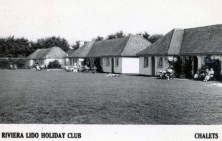
I only went to a holiday camp once; in 1967, along with half of Balham, we decamped (no pun intended) to Bognor Regis (so called because a monarch discovered swearing there).

I’d never been on a holiday where there was so much barbed wire; I told myself, as we drove our Ford Poplar through the camp gates, that Alsatians really were THE friendliest of dogs.

I spent a week there. As a ten-year-old boy, and because washing was anathema to me, I wore my newly-bought, from Frank Blunstone’s Soccer Shop on Lavender Hill, Peter Osgood’s No.9 Chelsea shirt the entire week.  (Dad refused to buy me a Gerd Müller top; to be fair, there wasn’t much call for these in Clapham Junction).  My friend from school came too, he wore a No. 10 Fulham shirt – denoting Allan Clarke (the footballer, not the lead singer from The Hollies).

There was an inordinate amount of sport to be played.

A consequence of the first book my dad bought me being the MCC Coaching Book, throughout the week I scored plenty of runs with my Colin Cowdrey bat (heavily aided by the fact that a tennis ball was used).

The week culminated with the lads vs dads football match.

If you’re ten you really don’t want to be playing against a team of people several feet taller than you, slightly stockier (!) and several having had many games in the Southern League under their ever-growing belts. “Chasm” wouldn’t even get close to a word describing the difference in class (Or height.  Or weight).

The first (and last time) I ever went for a 50/50 ball was against thirty-five-year-old Ron, who had been turning out for Hillingdon for years. Having previously innocently played on Wandsworth Common, where the toughest tacklers were squirrels, this was an eye-opener.

That summer of ’67 I played the innings of my life, realised I’d never make the first team of Hillingdon FC and discovered snooker, darts and pool – this was subsequently reflected in my O-level results.

“Ronnie’s up!”

A complete gîte

lighter

Having avoided being sent to elocution lessons when I was ten in 1967, my first taste of foreign languages, aside from my Nan speaking in rhyming Cockney slang to confuse her neighbours, was a year later at secondary school where they tried to teach us French.

Day trips to Dunkirk and Boulogne didn’t help; although did introduce us to cigarette lighters whose flames made oil rigs in the North Sea look tame – and flick knives.

But this was hardly immersion.  The only immersion likely was us trying to dump our Divinity teacher overboard just pulling out of Dunkirk harbour.

During our French lessons we were instructed solely to conjugate verbs. Because that happens in everyday foreign languages – Not!!  Whenever, trying to buy a fresh baguette on holiday in a gîte in a town which formerly housed U-Boats, you will not be saying to the Boulangerie, “I bake, you bake, he, she or it bakes, you bake (several of you baker types), we bake, they bake” you are English and, therefore, you speak slower and slightly louder, as if the baker is slightly mutton: “Have. You. Got. Any. Bread?”

Latin was just as bad. And useless, unless you wanted to study etymology or become a Personal Trainer.  Most Latin lessons involved us reading books about wars involving towns/cities/nations being taken by storm.  We learned the Latin verb expugnare – to take by storm.  I cannot remember, since my last Latin lesson in 1972, ever using the words “to take by storm” – although if I’d have supported Millwall that might have been different.

But, because English is the universal language, all we need to do is go to an evening class and learn how to say, in several languages: “Two beers, please”, “Where is the nearest chemist?” and “I think my clutch has gone!”

Auf wiedersehen, pet.

Waiting for a queue

waterloocitydepot

Have people stopped queuing for public transport? I’ve been promising myself, since 1974, the year I started commuting, to attend a “travelling in London” assertiveness course; it would seem this is becoming ever more urgent.

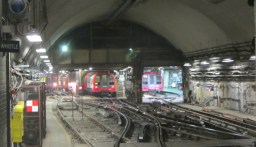
On the platform at Bank Station, connecting the Waterloo & City Line to Waterloo, there are markings behind which people would, with their rolled-up umbrellas, bowler hats and copies of the Times, wait patiently for the Drain as it is affectionately called, to arrive.

Not any more they don’t, plus the umbrellas have been replaced by invisible-to-the-wearer back-packs (probably containing a small person), whose sudden movement can remove an eye before you can say Captain Hook. Oblivious, they carry on listening through their headphones to something like “The Clash sing Edith Piaf”.

The markers on the platform are still very much there, but their existence is spurned.

I’ve noticed too that people no longer queue at bus stops.

Historically you’d form an orderly queue behind the bus stop. These days people congregate around the bus stop, mimicking vultures in the Nevada Desert, mentally preparing themselves to see the word “Due”.  This three-letter word pumps adrenalin through passengers’ veins as they lie in wait.

The bus is spotted and it is as if someone angelic host has said “On your marks…”, as there is an almost indiscernible shuffling towards where the bus door will open. The bus arrives and the ensuing pandemonium is on a par with a Boxing Day sale where tellies are suddenly available for under a shilling.

Planes are now boarded by the number on your ticket, this should be introduced for buses with priority given to people who never paid more than ten bob for a Red Rover.

Beaker people

peter bonetti

During the 60s and 70s, petrol stations started offering gifts when purchasing fuel; this was a relief for those into collecting memorabilia, but living somewhere where a vintage petrol pump might dominate the lounge.

The advantage being that 1970 World Cup coins were smaller than the actual pumps.

(I wrote about the advent of loyalty points last week at https://mikerichards.blog/2018/02/10/stamps-of-authority/)

There was an Esso garage on Balham High Road where my parents would fill up our Ford Poplar. I would as, a thirteen-year-old football fanatic, insist on visiting this garage; it was the only way we’d ever get Peter Bonetti into our flat!

As the years progressed (and you were prepared to queue for days during the 1973 oil crisis) you could collect glasses. I can only assume the principals at Standard Oil and British Petroleum believed that people in the UK, whilst owning cars, failed to possess a drinking receptible and were visiting tributaries of the Thames to drink water with their hands.

Soon many houses I visited had sets of glasses out of which you’d drink your squash; although always mildly tainted with the taste of four-star.

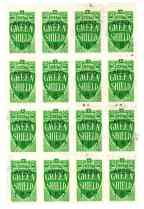
Some garages offered a dream, rather than faux cut-glass beakers, with the gratification of manifold sets of Green Shield Stamps; my parents would drive for miles looking for the biggest multiple.

Although, you’d easily swap several tigers in your tank for quintuple Green Shield Stamps.


Stamps of authority

green shield

I tried to get money out of an ATM the other day by mistakenly using my Kidney Donor Card; I had far too many loyalty cards in my wallet. I either needed to shed a few or buy a bigger wallet, a small travel bag or basket-on-wheels like my mum had.

There are very few shops these days where you’re not brandishing two cards – one to pay with and one to collect points. (Three, if you’re trying to break into the till).

Unlike in the 60s and 70s when you’d collect Green Shield Stamps or cigarette coupons, you knew exactly how much you had – eight and a half books or half a hundredweight of Embassy coupons. I wrote about this previously: https://mikerichards.blog/2017/01/03/gateway-to-the-south-revisited-2/

Because of this lack of knowledge of the worth on your loyalty card, I’m always hearing (predominantly in coffee shops): “Have I got enough points on this card?”, “No, you have 2p”. An ignominious silence descends.  In recovery mode, the question to the barista is: “Oh, where’s that flag from?” “Tuvalu.”  More silence.

But it is (no pun intended) rewarding redeeming points, even when you’ve paid over several hundred pounds to earn a couple of free Ginger Nuts in Costa.

Don’t get me wrong, these cards are useful; the alternative would be carrying around several bulging (freshly-licked) Green Shield Stamp books or several million Embassy coupons – you’d certainly need a bigger wallet – or a very strong elastic band.

I wonder, if I sold one of my kidneys, could I get the points put onto my Boot’s card?