Blog

Part A

slime

I never got a party-bag when I left any party I attended as a kid. In the 60s you’d get a piece of cake for your mum and an item of stationery: pencils for the girls, the boys would get rubbers (you can’t be too careful – even at eight!).

Neither did I go to a party where they had a child’s entertainer; you made your own entertainment: musical chairs (always won by people interested in Feng Shui), pass the parcel (where you got your first paper cut and the chance to get another pencil) and postman’s knock (which was a marginally more accurate introduction to sex education than learning about the reproduction system of amoebas at school).

Party bag ingredients these days is a serious and highly competitive business: personalised cup cakes are popular (just in case you’ve not eaten enough cake at the arty) and Slime.

If you’re of a certain age (61) think Playdoh, only more malleable. In the sixties the only slime you saw was if you were watching The Quatermass Experiment or your nan hadn’t probably cleaned out her larder during an unseasonably hot summer!

Growing up in the sixties there was no slime given out at the end of parties, just your parents explaining to the returning parents why Keith had had a nose bleed, how Stephen had fractured his ankle on a removable chair and that Josie was sick into the parcel being passed. We never played blind man’s buff – it was too dangerous as we lived on the fourth floor of a block of flats with dodgy windows!

Dogging is not just for Christmas

51vxdzmnvol._sl500_sx302_bo1,204,203,200_

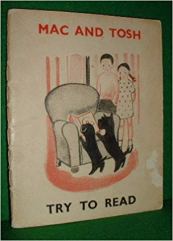
I never encountered Janet & John when I began to read at my south London school in the early sixties. My class was given Mac and Tosh (do you see what they did there?  I assume the authors also ran a chain of raincoat shops?)

I missed out on Here we go (Janet & John become football hooligans); Off to play (Janet and John discover the joys of truancy) and I know a story (where Janet & John learn the art of pathological lying).

No, I had two Scottie dogs helping me improve my four-and-a-half-year-old reading skills.

The early books were Mac and Tosh learn to read and Mac and Tosh learn to write.  I moved on from this series quite quickly and assumed the next editions covered: Mac and Tosh learn elementary computer programming and Mac and Tosh secure world peace.

Because I progressed away from books with lines like here is the dog; we like the dog; John likes dogging, it wasn’t until I was in my mid-twenties that I learned that dogs can neither read nor write.  I blame this on Dr Doolittle and watching too many episodes of Mr Ed.

Finger lickin’

penny_black_vr

My walk to school in the late 60s would, every day, take me past a stamp shop.  The shop, near Tooting Bec Station, was next to a baker’s, where the smell emitting from the bakery was so foul I was drawn ever nearer to the stamp shop next door for comfort and often considered collecting stamps.

My dilemma was not knowing the difference between a Penny Black stamp and a Green Shield one (although I look back and think, if I’d owned a Penny Black, I wouldn’t have needed to lick as many Green Shield stamps as I did to collect the required amount for a flannelette sheet).

I would, most Saturdays, journey to the stamp shop, with a peg on my nose to avoid the acrid smell emanating from the next-door bakery, to buy some stamps.

I bought an album, a set of hinges and an implement which you dipped the hinges in, so you didn’t die of thirst with too much licking (I nearly bought one using Green Shield stamps but had dehydrated by the time I got to the shop in Clapham Common).

I quickly realised that my half a crown pocket money was never going to buy a Penny Black (or even a perforation off one) so my plan B was to buy stamps with modes of transport on.  Most people would collect stamps from specific countries (or Penny Blacks), but I was content with stamps with Concorde on or the occasional hovercraft.   My album consequently had no value, but I believed it could float on water or travel at super-sonic speeds.

It was only when I was older that I discovered the official word for collecting stamps was fellatio; more of that next week when I talk about my rare Blue Mauritius!

River deep, Streatham High (Road)

streatham4

In the 60s, my mum took me twice to the Streatham Odeon: once to see Mary Poppins and once to see The Supremes.

I saw them both in quick succession and wondered, halfway through Love Child, why Julie Andrews wasn’t in the line-up?  And why they ended the concert singing Baby Love and not A spoonful of sugar?

When I saw The Supremes, Diana Ross had left the group to commence a career starting World Cup Finals and I thought I was well within my rights to expect the expert nanny, together with her magical umbrella to be on the stage singing You can’t hurry love. (This song was originally written for the 1937 Cockney musical, Me and My Girl and the version was to have been called, You can’t hurry, love.)

I’m thrilled, however, that the Streatham Odeon is still functioning as a cinema; the Balham Odeon is now a Majestic Wine House – not so much Kia Ora more a fine Beaujolais and the Mayfair Tooting is now a bank (via, in the 70s, an upmarket snooker hall – which, of course, in Tooting, is oxymoronic) and will probably end up being a pub – as most old banks do.

I suppose there is a link, as the grocer where Mary Poppins bought her sugar was called Nathan Jones.

Three Amoebas

granada

In September 1968, after a series of exams and interviews, and having gained a place at my Tooting grammar school, I was amazed that the first set of homework was to cover our text books.

I was anticipating, in my first week to have gone home to split the atom; remembered the dates of the reigns of all the Anglo-Saxon monarchs or knowing that in binary 01000101 is 69 (which, when you’re 11, is just another number).

Over the next few days we would all come back to our school rooms with our books adorned in whatever material our parents had left lying around our houses.

Most had used brown paper, one or two had gone down the wallpaper remnant route, with one boy coming in with his books covered with red, flock wallpaper which looked suspiciously like the same wallpaper which decorated the Granada Tooting; I never went to tea at this boy’s house but I’d have bet his carpet would have had the word GRANADA inscribed into the weaving.

Another lad came in with his books bedecked in Thunderbirds wallpaper; sadly, for him, in the teachers’ eyes, Thunderbirds were not “GO” and he consequently got a detention – even Virgil Tracy couldn’t rescue him from that!

The homework did get harder: the toughest assignment being charged with looking after the class amoeba (this was a grammar school, so no run-of-the-mill hamster) for an entire weekend, making sure it didn’t die or get impregnated by other organisms.

Candlewick green

candlewick

It is that time of year when you have a momentous decision to make: is it time for the winter duvet?

Growing up in the 60s in London duvets were things people only used in northern Finnish ice huts. It wasn’t until the 70s when Brits realised that duvet didn’t rhyme with rivet.

Now everyone has a duvet; and most people now know that tog is a unit of thermal measurement, as well as being some bizarre creature in Pogle’s Wood.

But was there, in the late 70s, a massive chucking-out of sheets, blankets and, most importantly, candlewicks? Were there suddenly heaps of discarded eiderdowns at the local tips?

I had a blue candlewick, which, over the course of many years constantly picking (which prevented other potential adolescent nocturnal activities (and still I have dreadful eyesight!)), ended up with more holes than actual bedding – I’d have been warmer with a giant Polo covering me!

Perhaps “continental duvets” featured heavily in The Champions or The Persuaders which encouraged us and our parents to hurry down to Brentford Nylons to purchase this Scandinavian wonder night-time protection?

I miss my candlewick, holey that it became, and would be comforted by it in the dead of night in my quiet Balham flat, if ever I woke, to see the beaming, and comforting face of Captain Scarlet – half hour later I’d wake up thinking the Mysterons were in the room – they weren’t – they were burglars.

Sponge, anyone?

tommy baldwin

Growing up in the 60s, Balham Woolworth’s was the place we’d get our Christmas tree each year.

They weren’t as easy to nick as the contents on the Pick ‘n’ Mix on the counter, so temptingly near the entrance, so we bought ours.  This was also the place where we’d also purchase our decorations: which, because they were so fragile, by the time we’d get them back to our flat, and with an attrition rate of around 67%, we’d leave a trail of shattered glass/plastic in our wake along Balham High Road.

The biggest argument, however, was what to put on the top of the tree. As a small child we’d have a fairy/angel and then a star as I got older.  Upon entering teenage years there was a perennial internal family fight as to what perched at the top of the tree.

We all had varying hobbies and interests: my mum wanted a packet of JPS, my dad, despite being a massive Chelsea fan, wanted a picture of Vanessa Redgrave and I wanted a model of Gerd Müller.   We compromised, and for several years the pride of place atop our tree was a model of Tommy Baldwin wearing a Germany shirt made from old cigarette packets.

Blob on the landscape

blobby bow tie

The record which topped the charts during my first Christmas, in 1957, was Harry Belafonte singing Mary’s Boy Child which is When a child is born played backwards.  It wasn’t until 1967 with The Scaffold’s Lily the Pink, that the Christmas songs became novelty songs – you’ll never hear the choir of King’s College Cambridge singing Ernie during any of their Nine Lessons & Carols services.

1956 had Johnnie Ray singing Just a walkin’ in the rain – if he’d had released that during Christmas 1962 he’d have had to have changed the words to Just a walkin’ in the snow as Britain witnessed its worst winter since the Black Death.

Is it, that at Christmas, peoples’ music tastes change so dramatically that they are bound to buy the worst record that week?

Why would you buy Long-haired lover from Liverpool (1972) sung by someone who’d rarely travelled outside of Utah?  In my view the 1980 hit There’s no one quite like Grandma is correct – my maternal grandmother had no teeth, stockings which were never fully pulled up properly and the most vituperative person ever.  And Mr Blobby (1993) – if Mr Blobby’d been one of the three wise men, then fair enough, he deserves a Christmas No. 1; but he wasn’t unless there were actually four wise men carrying gold, frankincense, myrrh and a yellow, spotted bow-tie.

Bring back Johnny Ray singing Just a walkin’ in the disturbingly mild for the time of year.

Vinter Vonderland

snowball

“Holidays are coming” says the Coca Cola-fuelled TV ad six times, as the British public awaits the now famous ads for Christmas.   Growing up in south London in the sixties there was never that anticipation of exciting TV ads – mainly because there was only one commercial TV station and the only thing anticipated was how much Cinzano Leonard Rossiter might spill over Joan Collins or the shock of the inarticulate Lorraine Chase talking about Luton Airport.  (Says he who bunked off elocution lessons when 10).

However, there was one which I remember vividly and was in that box of things (like dates) that you only devoured at Christmas; that was promoting Advocaat (particularly the brand made by Warninks – pronounced with a “V” as if you were playing a German in Hogan’s Heroes).  Suddenly a snowball wasn’t something you remembered making in 1963, or a leading character in Animal Farm, here was something your parents gave you in an effort to put you off drinking alcohol at Christmas – and subsequent decades.  It’s like if custard was alcoholic!

My favourite Christmas ad from times gone by still remains the one marketing various forms of fragrances for Morny’s talc – although rather than the line: “Morny – the natural choice for Christmas”, I’d have preferred: “Because everyone suffers from chafing sometime”. Probably why I never made it in a creative department of any ad agencies in which I worked.  To which I say “Bols”.

Rum ‘n’ raison baby Jesus

advent

I’d like to know when the baby Jesus got replaced by a KitKat?

It is now Advent and Advent calendars are in evidence; in some shops they’ve been available since August Bank Holiday.

Advent calendars these days contain sufficient chocolate to raise your cholesterol levels by 10%, but when did this start?

Growing up in the sixties, when you got an Advent calendar at the start of Advent and not at the beginning of the grouse shooting season in mid-August, behind the twenty-four tabs were pictures of likely presents and Christmas-related things: a spinning-top, some holly, a snowman (especially if your town was twinned with Reykjavik – I think Balham was, but only for 1963).

The flap with the number 24 on hid a picture of the aforementioned baby Jesus. Today, people are disappointed when it’s not the daily output of the Bournville factory behind any of the flaps.

If I were the Archbishop of Canterbury, my Christmas Message this year would be directed at the British Dental Association. I blame them; although KitKat is marginally tastier than cardboard!

Lo, He comes with clouds descending – only this year with added caramel filling.