Norway: null points

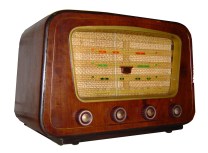
old-radio

Starting next week Norway, a country famous for regularly achieving “null points” at Eurovision, ranting racist (but with very good knowledge of UK history) football commentators and introducing the world to the word “Quisling” is to start switching off its country’s FM radio signal.

I am sure there will be many Norwegians from Oslo to Narvik who may not possess a digital radio.  There may be many inhabitants of Hammerfest who only own transistor radios; their only form of entertainment from next week could well end up being “pin the tail on the herring”.

This move to digital-only radio will also happen in the UK and I’m reminded of the joy different forms of radio has given me over the years as well as increasing my myopia.

The block of flats in Balham where I used to live had, when it was first built in 1936, radios installed into every flat.  They would play the Light Service (this had programmes with a lot of people saying “can I do you now, sir?”; the Home Service – mainly news read by virtually anyone except William Joyce and the Third Programme which cheered everyone up during the war years playing mostly Mahler.

By the 60s most of the radios hardly worked.  In my Nan’s flat it still worked but you had to go inside a cupboard in which it was housed.  I spent many hours inside this cupboard listening to programmes such as “I’m sorry I’ll read that again” and deciding which Mahler symphony I liked the least.  As well as the radio, also inside my Nan’s cupboard lay the central heating system; it was very hot inside the cupboard.  I remember after 30 minutes of “The Clitheroe Kid” I’d lost half a stone.  After the radio stopped working my Nan would hire out the cupboard to apprentice jockeys hopeful of a ride at Epsom.

I also had a transistor radio and would listen under my covers to the Top 30 on Radio Luxembourg; under torchlight I would write down the charts as they were played.  This is something I’ve never admitted to my optician – or psychiatrist.

I remember listening to a lot of sport on medium wave; Police activity on short wave (always handy when living so close to HMP Wandsworth) and long wave with my ear very close to the in-car speaker to Test Match cricket when not in the country, but you could see it from France.

I will bemoan the move to purely digital, but first it will be manifold Norwegians who will no longer be able to tune in to “De Bueskytter – the everyday story of fiord folk”

 

Gateway to the South (coast) revisited – 4

On a rare break away from the flats dominating Balham High Road I was sent away on several summer holidays with my paternal grandparents.  Many of my teenage years were spent in Greatstone which is on the Kent coast and near to the Dungeness power stations; wearing a safety suit when the tide went out precluded playing on the beach and certainly gave me a dodgy bowling action as I tried to twirl my leg-breaks (this is not a euphemism).

In 1973 I was on holiday in Greatstone.  This was my O-level year where I set a record for spending the least time in the school hall during the exams.  I feared the worst.  The realisation came from a call home when I duly reported in and spoke to my mother – one of the two parents who had, throughout my secondary school career, been constantly told that “Michael could try harder”.  She told me, “we opened the envelope and you got one O-level; your father’s bleedin’ furious”.

But all was not lost, as, over the series of many summers, I learned the names of all the engines on the Romney, Hythe and Dymchurch railway and learned, having read the Dr Syn novels, believed that life as a smuggler may be the employment route I was destined for with my one O-level.  Or, as my O-level had been in English Literature, I thought of being a Scottish King, a miserable prince in Scandinavia or a man who removed thorns from lions.

I never made it as a smuggler, the barrels were too heavy and found that absinthe made me come out in a rash.  Also, I don’t suit a bandana – it messes me hair up.

Gateway to the South revisited – 3

dcc-courtyard

One of the flats in which we lived in Du Cane Court had its windows backing out onto a courtyard.  Any sound would echo around.  By the law of averages one of the inhabitants within the 627 flats (we counted them all one wet Bank Holiday Monday) would be a mad person.  Mr Philips was that man in our block.  I remember one hot, summer evening, when the windows were open but a quiet air of peace hung over SW17, when an utterance, through the silence and reverberating around the courtyard came from said Mr Philips: “turn that fucking radio down!” he shouted like the opening of Billy Cotton’s Showband programme and then suddenly back to a silence like a grave.  We think that Mr Philips may have previously been a Radio Caroline DJ and was never reconciled to the fact he was no longer afloat.  He certainly wasn’t mentally.


Gateway to the South revisited – 2

emabassy

My nan lived next door to my Auntie Vera.  Her husband, my Uncle Ted, was a semi-professional band leader.  This took him up to town every Friday and Saturday evening.  To occupy herself during my uncle’s absence, my Auntie Vera would go 100 yards across Balham High Road to a gaming club frequented by the Krays called the 211 Club.  Situated at 211 Balham High Road, the 211 Club used to be the Balham Conservative Club.  Pre-Ron and Reg it boasted several bars, snooker tables and a massive garden.  As the 211 Club the snooker tables were replaced with gaming machines and Black Jack tables.

One evening my Auntie Vera was entertained by Jack “The Hat” McVitie.  Sadly, she never left her flat with her autograph book, so she may have lied, although she isn’t currently a central support of the then recently-built Westway.

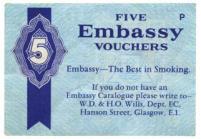
When not in the 211 Club she would smoke Embassy cigarettes; my job was to count them.  She was saving up for a set of new towels – “you can never have enough towels, Michael” she would say (in between coughing).  Sadly, she died of emphysema.  Looking back she should have been saving for a new lung, the towels could have waited.  She could have used my Uncle Ted’s vest; he did.

In addition to being a professional smoker, my Auntie Vera was an accomplished pianist.  It was decided she would teach me.  After two lessons and being severely wrapped over the knuckles with a steel ruler I decided that Kendo (with me not being armed with a stick) would have been less painful.

However, it was my Auntie Vera who, when I was six in November 1963, came out of her flat to greet me and my nan en route back to my parents’ flat, with the news that Kennedy had been shot.  I assumed, given her violent nature and the company she kept when my Uncle Ted was away, that perhaps she’d been the person who’d shot the American President.  In Du Cane Court they had lovely gardens, but not a grassy knoll to be seen, so my Auntie Vera was innocent.

Gateway to the South revisited – 1

Having been born where Albert Speer died and Sir Alexander Fleming discovered that, if you left bread out long enough, it’d save going to the pharmacy within St Mary’s Paddington to get Penicillin, my parents decided that a room in a road just off Baker Street wasn’t the place to bring up their little Mickey Mouse, so we emigrated south of the River (it was before 8.00 pm so cab drivers were happy to take us) to a 1936-built block of flats located on Balham High Road, SW17. My maternal grandmother lived there, next door to my Aunt (her sister) who was sponsored by Embassy before they got into snooker and their step/real dad respectively.

Because I was moved there when I was only nine-months my early memories are negligible but, as I lived there until I was fifteen (we had to move as my mother had run out of maintenance people and shopkeepers along Balham High Road to shag) I collected many memories.  I will choose this vehicle to share with you.

Having started with a leading Nazi, this first chapter will end with one of my most vivid memories.

Within Du Cane Court, the flats of which I mention, there was small dairy-cum-grocer’s shop; most of the tenants would visit this each day.  In the 600+ flats you could count the number of children living there on the fingers of two hands, one of which having had an accident with the bacon slicer in the dairy.  One of the other children’s mum was German.  I remember her one day saying to my nan and me that her cousins had all been in the SS and that you could not have met nicer people.

I can only assume, within the Third Reich, they never had “take your cousin to work day”?