Blog

No laughing policeman

morden

The couple living in the third-floor flat below my fourth-floor flat in Du Cane Court often came to complain to my parents about the noise I made. They had no children, but they were massive golf enthusiasts (and with hearing like bats as far as I was concerned). One day, rather than listen to me re-enact the Cassius Clay/Henry Cooper 1966 fight, they invited me to go, with them, to the driving range at Addiscombe.

I loved it and was hooked.

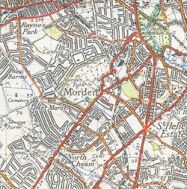
During the summer holidays my friends and I would walk to Balham Station and get the Tube to Morden (several of my fellow-travellers believed, once we exited the station, we’d fall off the end of the world. After several trips, there was more chance of being invited to drive a trolley-bus down Balham High Road) to play the championship course which was Morden Pitch ‘n’ Putt.

Whenever I visit other golf clubs and am asked to enter my club’s name, I still write “Morden Pitch and Putt GC” – probably one of many reasons I’ve never been invited to be a member of the R&A.

Having bought a putter and a sleeve of Dunlop 65 balls from Balham Woolworth’s, I practiced for hours in my bedroom.

In between pulling down the big, old houses on Balham Park Road and erecting the new houses, thus creating Hunter Close, there lay a building site. This was, for a very brief period, to be our Augusta.

As a teenager, and having mastered my putting rather than doing my geography homework and having bought a selection of second-hand clubs from the second-hand shop on Balham High Road near the Duke of Devonshire (I think it may have been called Décor), we were all set for the Balham Masters.

We played one Thursday evening and, even though I say so myself, hit the ball quite well.  It wasn’t until the following day, that the Police informed me of exactly how well I’d hit it.  Unbeknownst to me I’d smashed one of the windows of one of the Du Cane Court flats; equally ignominiously, the window belonged to one of Du Cane Court’s minor celebrities: Harry Leader.

Harry Leader was the front man of the highly originally-named band Harry Leader and his Band.  He had appeared on the radio and briefly, as he’d discovered Matt Monro, in the popular weekly TV programme This is your life. This fateful evening I had a local bobby tell me: “This is your golf ball!”

Our cause wasn’t helped as the Police refused to believe the answer “choir practice” to the question, “Where have you been this evening?” and then, as all of us thought we were heading for a ten-stretch at Albany High Security Prison (we were only 16 and horribly naïve) they found a book one of my fellow-golfers had purloined: Boys and Sex.  Because the book was confiscated, many of us within the group didn’t discover masturbation until well into our twenties. (Luckily my eyesight was already dreadful and this possibly ensured its arresting).

I still play golf, but have this dread, whenever playing at a course where you’re playing near a clubhouse, that, if I were to break another window, the Sweeney will arrive before you can say “get your trousers on – you’re nicked”. FORE!!!!


How do you solve a problem like Gerd Müller?

muller vogts

1973 was a momentous year: we joined the EU and (more importantly) I took my O-levels.  Due to EU legislation these are now called GCSEs.

The day I got my results has been recorded before: https://mikerichards.blog/2017/01/05/gateway-to-the-south-coast-revisited-4/

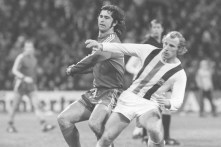
To celebrate this grand union, the three new entrants, Great Britain, Ireland and Denmark played football against the six existing member states: Belgium, France, Italy, Luxembourg, the Netherlands and Germany (well, the bit of Germany not run by the Stasi). The game was held at Wembley; with the West Germans insisting no Russian ran the line.  For the Six (as they were known) there were many players you’d have had in your team up the common – Beckenbauer, Netzer, Gerd Müller and the Dutch player, Neeskens.  The Three had Arsenal, England and Ford Open Prison right back, Peter Storey.

It was fantastic seeing these great players from differing nations playing for two super teams. Of course, we have this today: it is called the Champion’s League. In 1973 this was a massive novelty as we celebrated joining the Common Market.

The year before we’d been celebrating the onset of the three-day week and my school had merged with the school across the rugby field and imaginatively called Bec-Hillcroft before they discovered Ernest Bevin once shopped at Tooting Broadway Market.

I was taken out two-thirds through my 4th year at Bec and sent to Emanuel.  I passed the entrance interview with the headmaster, not because of my academic prowess (I defy anyone who went to Bec to have had as much red biro strewn over their homework) but because the head was drunk and I could successfully juggle three empty bottles of Gordon’s Gin.

Whilst this move in theory was sensible, in practice it was a disaster. What my dad and I had underestimated was the different syllabuses between the two schools.

Having learned every nook, cranny and ox-bow lake along the Rhine Rift Valley, I soon discovered my newly-acquainted fourth-form classmates had been learning about northern America. I knew about Essen, they knew about Eskimos.

I knew every (bloody) word of Pygmalion while my fellow English Lit pupils pranced about the Quad (that’s what they called the playground at Emanuel) pretending they were Lady Macbeth; some of them were quite realistic as they were going through puberty and you never quite knew which octave they’d speak in. Some were handy with a dagger too.

Having done special music at Bec and could hum most of the overture to Weber’s Der Freischutz, my fellow musicians at Emanuel knew every single line to Britten’s A Ceremony of Carols.  I was 121 years behind!

I never bothered with science at Emanuel as giving the answer of “is it a little pip?” to the question “what is a pipette” during my first chemistry lesson, I was destined never to tamper with a Bunsen Burner ever again.

During the exams themselves I remember spending as little time possible in the hall which doubled as the exam room at Emanuel; Ileft most exams after 30 minutes.

I do remember being asked for Music O-level to write a short biography of Federic Chopin. Having swapped schools I was blissfully unaware of him and knew more about Peter Storey.  I liked to think, if he hadn’t got involved with fraud after finishing his football career, he may have written polonaises, etudes of even a three-year (rather than minute) waltz?

So, as we are about to countdown to leave the Common Market we joined in 1973, I’ve no regrets I never continued French O-level at Emanuel.  In two years’ time, if I travel to France, I shall simply speak slower and louder.

So long, farewell, auf Wiedersehen, adieu, as Baron von Trapp, who came on as a substitute for Berti Vogts in that 1973 Three vs Six game, would have said.

Lice, damned lice and steel combs

comb 2

There were, at various stages throughout your school career, times when medical matters loomed on the disinfectant-smelling horizon; although it seemed to go up a gear at secondary school.

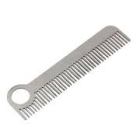
At St Mary’s primary school in Balham I can only remember seeing a nurse a few times – each time armed with a steel comb (these were the days when buzzing combs had yet to be invented) and a glass of disinfectant. After the visit of the nit nurse your hair stank of Dettol and was probably highly flammable until bath night.

Secondary school was like an episode of M.A.S.H. compared with primary school.

In the first year at Bec we had the cough and drop test. I failed.  I was given a card which said “Ascended right testicle”.  I took this home to my mother who knew one of the three words.  I explained to her what this meant.  She was livid.  Not at the fact I’d had an undescended testicle but that I’d not been diagnosed with malnutrition.  I was disturbingly skinny as a kid and was given Virol – a malt extract probably designed by dentists as it was 101% sugar.  Because, as my mother put it, I looked like something out of Treblinka, she was disappointed I’d been told I had something she only knew 33% of.

In the second year we had BCG tests – this was to check if any of us were going to get TB (or consumption if you were examined by an older teacher or the King’s Evil if your school doctor had been reincarnated from medieval Europe). It was also to prevent any of us becoming 20th Century Elizabeth Barrett Brownings – which was unlikely as no one was very good at poetry in my year at school.

The procedure was called the Heaf Test (named after the then PM, Ted Heaf) involved having, what appeared like a multi-staple gun on your arm. It was quite painless.  You waited a week.  If the mark of six spots had gone, you got the BCG injection (and sent to play rugby immediately after); if the mark was still there, you got another note to take home to your parents suggesting a chest x-ray.  Mother was furious, a year on and still no diagnosis of malnutrition.  Plus, Virol wasn’t cheap

We never got tested for Rubella at our all-boys school. I assume, once Brexit is officially triggered on March 29th, Rubella will go back to being called German Measles?

“A handbag?”

make up

Whilst there was plenty of mischief to be had growing up in Balham and Tooting, I was fully occupied during most evenings as I sang in two choirs (they met Tuesdays andridays and because of some event on Mount Sinai some years before, twice on Sundays – although you did get wine) and attended an amateur dramatics group Mondays and Thursdays. I knew all the words to Hello Dolly by the age of sixteen, but ironically went on to have three children.

Every year the Am Dram society to which I belonged would perform a pantomime or musical once a year as these would create the biggest interest to the not-too-discerning musical public of SW12/7.

My first thespian part was as the man servant in Me and My Girl. I had one line, “This way, Mr Snibson” as I ushered the star of the show into the front room for him to introduce the upper classes to The Lambeth Walk.  It took me several weeks to master the line and to decide the correct inflection on each word:  “THIS way, Mr Snibson”, “This WAY, Mr Snibson”.  I even contemplated method acting and becoming a man servant for a year, but the play was set sixty years’ prior as manservants were fast becoming a thing of the past.

From this, I slowly progressed and, because I could sing, was given the part of Buttons.  Luckily it was Cinderella. A mate of mine was also in the group, but not a good an actor; he got given the part of Pontius Pilate.  It took him until the end of the final show to realise this wasn’t the biggest part he could have got.


One of the songs I had to sing was “The Ugly Duckling” famously performed (and written) by Danny Kaye and latterly Mike Reid. It was in the style of Mike Reid – bringing Danish folklore into Cockney reality – was what the producer expected of me.  Because I could read music, I sang the song using all the notation suggested on the sheet.  After I’d sung the song the producer complimented me and said I’d sung it wonderfully.  Sadly, he added, I’d made it sound like a church motet.  Think Chas ‘n’ Dave singing the Mozart Requiem only in reverse.

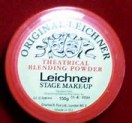
One of the disadvantages of Am Dram was having to wear make-up (I was never allowed to use my own) which showed up under strong lights. The smell still lingers (like Virol or calamine lotion, which was liberally applied when you had chicken pox) as did the make-up itself if you were mid-teens and hadn’t quite discovered washing (or girls).  During show week and after every performance I’d go into school the next day.  I think I was the only person at Bec Grammar ever to play an entire house rugby match wearing full stage make-up.

The zenith of my amateur thespian career came when I was given the part of John/Ernest Worthing in Oscar Wilde’s The Importance of Being Earnest”.  Luckily there were no songs to sing inappropriately, but there were many lines to be learned.  However, and not for the first (or last) time in my life, work got in the way and a consequence of me having to be on some advertising course and missing several dress rehearsals, the play never went ahead.  Oh well, that’s showbiz, I guess. Plus, I never got to say the words, “This way, Lady Bracknell”!

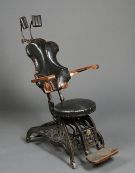
Tooth hurty

dentist

As a kid, I could have easily become either a dentist or a crack addict. The dentist was the preferred option as a child as I’d visit two – one on the corner of Ritherdon and Balham High Road, the other on Crescent Grove facing Clapham Common.  Both were huge houses and, because I was nearly thirty before I physically lived in a house, I wanted to own a massive detached Victorian house when I grew up (toothless or otherwise).

Because my diet was very sugar heavy – you could buy four shrimps and a Jubilee Bag for less than a sixpence and you could raise your cholesterol level in most Balham sweet shops for less than half a crown (the exact monetary value of a portion of big, big carpet-cleaning 1001), my trips to the dentist as a young teenager were more regular than the mandatory six-moth visits. I would (officially) go in April and September. April was chosen as invariably I’d be on school holidays.  One year my mother sent me on my birthday:  Happy Birthday – here’s your present of an amalgam of mercury, copper, tin and zinc – hardly Gold, Frankincense and Myrrh!

Nowadays a drug called Lidocaine (originally invented by a swimming dentist who was a regular at the Tooting Bec Lido) is used for pain prevention, when I went, and you didn’t have gas, the drug was cocaine. It was injected, you didn’t have to bring your own rolled-up ten-shilling note, although, if you did possess a ten-shilling note, imagine how many Jubilee Bags you could buy?  Death by sherbet dab!

The dentist lived on-site with surgeries and waiting room on the ground floor, no doubt above this there were countless rooms filled with recently-extracted rotting teeth. The dentist must have been wealthy living in such palatial splendour, but this, to me raised one question: why were the magazines in the waiting room always out of date?  Before one appointment (in the mid-Sixties) I read, with relief, that Crippen had been apprehended and mother was one year so pleased Mafeking had been relieved.  She knew a Mr Mafeking and wondered if this was something she’d been involved in!

There was always a disappointing selection of magazines, not like the barber’s whose waiting area was stocked with copies of Parade and Health & Efficiency.  It was only when I went to get my haircut that I took such an ardent interest in naturism.  The only chance of sneaking a look at a pair of boobs in the dentist’s waiting room was if they had the 1958 edition of National Geographic which featured ladies from a remote village up the Amazon wearing nothing but a fish-harpoon.

Although I think about it I wouldn’t have wanted to be a dentist – all that halitosis. Plus, you’d never have a decent conversation – unless your patients had the gift of being able to talk with the entire Screw-Fix catalogue in their gobs!  Although I would like to use the word gingivitis at work more.  Gingivitis derives from the fact that St Vitus was ginger.  Open wide.

My padlock’s bigger than yours

padlock

It is ironic, given my most feared lesson at Tooting’s Bec Grammar School, was PE, that I now religiously and willingly attend a gym on a Saturday (Bayern home games permitting) and Sunday (when not serving as an acolyte at the Epsom & Ewell Buddhist Temple for Latter Day Saints).

At Bec we had a PE teacher (for teacher read sadist), Mr Scrowston, who you couldn’t have made up. He didn’t tend to mix with the other teachers and had his own “office” which housed an awful lot of rugby balls, hurdles and shot puts.  There is a line in the film “Hospital” where the star, George C Scott, suggests one of the nurses was trained at Dachau;  I often used to think that Mr Scrowston learned how to teach cross-country running there as he dished those out as punishments.

I could never fully understand why I was so rubbish at PE. I had good hand/eye coordination, but could never climb a rope, jump a buck or successfully execute an angled-head-stand (with or without the aid of my partner).

I recall one moment when Mr Scrowston entered one of the classrooms, prior to us sitting a particularly important geography exam, to tell us the results of the PE tests we’d had the previous week. I and two other class members (out of thirty) had failed to achieve a single point and were therefore punished with a cross-country run at our earliest inconvenience.

In the 4th Year, double history preceded PE.  I would sit in abject fear of what was about to happen in the bowels of the school gymnasium where the surrounding wall-bars I swear had been made from the bones of former pupils who’d also obtained 0% in their PE test.  This innate fear explains why I remember precious little about why Home Rule was considered a good idea by the then PM William Gladstone. Oddly I did remember that Gladstone’s hobby, aside from tree-felling, was rescuing fallen women.  As a very immature and naïve fifteen-year-old, I believed that “fallen women” were clearly women with inner ear problems and that Gladstone was always hovering on the corners of streets near Westminster ready to break the fall of these ill-balanced women.

It wasn’t until I’d read back copies of Parade in Ron and Don’s barbers in Chestnut Grove, Balham that I realised why I’d never make it as a doctor, and certainly never a gynaecologist.

Nowadays there is no one telling me I’m windy, a particular synonym for cowardice in Mr Scrowston’s eyes. During an inter-house cricket match I was facing some particularly hostile bowling and before one ball I had walked towards square leg.  “Richards, you’re windy” announced Mr Scrowston, “cross country run!” – I was automatically given out and sent to run round Wandsworth Common – twice!

The only torment I get at the gym is from 50% of the members who are Chelsea fans and taunt me with memories of the 2012 Champion’s League final. I blame myself as I turn up every weekend with my shirt with number 25 and the name “MÜLLER” on the back.

This week at my gym they introduced a new security system: one involving padlocks. You had to provide your own and it seems that not only does peacocking prevail in the showers (I blame the water being cold, so I don’t take part in that) but now it seems the bigger the padlock the more important you are in the changing rooms.  There are some padlocks which wouldn’t look out of place at Fort Knox.

But not only have you got to remember bringing a padlock, you have to have a sports-related number for the combination.  I have a very good friend at the gym who has decided, as his combination, to have the 1988/89 Chelsea formation (see, there is no escape).  Genius – until Graham Roberts becomes a member of our gym.

I have a small padlock (enter your own gag here) which needs no combination number. Consequently, I now have padlock envy.  I spent an hour jogging, rowing and doing things on the cross-dresser this morning wondering, if I had a padlock with a combination lock, what that number would be?  I decided on 1868, the year Gladstone first became Prime Minister.  Because, whenever I think of Gladstone, I think of doing PE and that is motivation enough.  Although, I look back on my Bec PE lessons and even if I’d have tried trying to vault over a horse, I may have saved time by not needing a vasectomy.

Odd-shaped balls

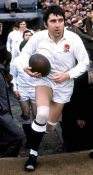
Rugby Union - Five Nations Championship - England v Ireland - Twickenham

I was fine playing football on the cinder pitches of Tooting Bec Common for my school, St Mary’s, Balham. I’d play at left back, not really getting involved as, even though they were an old pair, I wore glasses.

I’d worn glasses since I was five; my dad established I needed them having spent an afternoon of not picking his chinaman round the back of the garages of the Du Cane Court flats where we lived. I think my dad invented the doosra and was Balham’s answer to Muttiah Muralitharan.  I was taken to David Mercer, the optician in Tooting High Street to get fitted with NHS glasses, which had just been paraded at the Paris Fashion Show (not).

When I first went to Bec Grammar School in the Autumn of 1968 I was abruptly introduced to rugby. I’d never seen, let alone try and get one out of a loose ruck, such an odd-shaped ball.

Because of the inherent danger of having a fellow classmate handing me off (this is a rugby phrase and not a euphemism, there were rarely happy endings in my short rugby career) my glasses could easily break, thus rendering my myopia even worse. This was the boy who couldn’t read the large letter at the top of the opticians’ chart with his right eye covered.

Our teacher for rugby (and oddly General Science) was former Bec Head Boy, Bob Hiller. Mr Hiller was, as a former pupil and England’s full back (I thought George Cohen was England’s full back such was my knowledge of rugby), untouchable.

We had two rugby tops: navy blue and white.

Without my glasses I would see three balls coming towards me; it never occurred to me to go for the middle one. Having spent 80 minutes (which seemed like 80 days, there is a ring to a book entitled 80 days round Tooting Broadway) my shirt was still spotlessly white.  I didn’t get involved at all.  I’d stand, freeing  to death, on Fishponds playing fields, like Molesworth’s Fotherington-Thomas; thinking Arcadian thoughts and nothing about rugby.  Mr Hiller, in his infinite wisdom, decided I needed to get dirty and forced me to rub mud over my shirt (he was clearly sponsored secretly, in those days of rugby being an amateur sport, by Daz).

I stupidly told my mum.

My mum, in turn, and even more stupidly, wrote to Mr Hiller. No one has the right to make her little Mickey Mouse dirty for no ostensible reason.  I was a marked man.

Luckily I redeemed myself in the summer as I was, for a ten-year-old quite a good cricketer and had inherited my dad’s finger-spinning ball skills. I was deemed so good I was sent to play for Wandsworth and to report to Al Gover’s cricket school.  However, this was time off school and I never went.  I bunked off. I could have been the next Shane Warne; I was never going to be the next JPR Williams.

From Balham to Bayern

1967_european_cup_winners_cup_final_programme

Football allegiances, I believe, can be categorised into three sources: supporting your local team (very laudable); glory seeking (glory seeking) and parental indoctrination (who pays for your food?).

Balham United, of which the caretaker at my school, St Mary’s on Balham High Road, kept goal, was my local team growing up. They never featured on the ladder you could get at the start of the season in Shoot so I followed my dad’s team.  Dad went to Stamford Bridge for every home game and was a massive Chelsea fan (or Speedway as they had that when he was going, let’s stick to Chelsea or this article will become irrelevant very quickly).

Throughout the 1966/67 season my dad would take me to the Bridge. This was a time when football violence was becoming endemic and I was conscious of the intimidating atmosphere.  Dad and I would walk from our flat in Du Cane Court to Tooting Bec Station and get the 49 bus towards the home of Chelsea FC.

My dad was so keen to make me a Chelsea fan he took me to ex-Chelsea player Frank Blunstone’s shop on Lavender Hill and got me a Chelsea kit with a number 9 (Peter Osgood) on the back. There was no sponsorship, no team name.  The Chelsea logo on the front and the number 9 on the back.

On Saturday, May 20th 1967, Chelsea lost 1-2 to Spurs in the FA Cup Final (which this year, as I write this, will possibly be contended between non-league sides, Sutton and Lincoln – modern day Balham United equivalents).  I had decided, from my armchair, that this team was rubbish and the quest for a new team began.   I was, I hasten to add, more interested in cricket, but peer group pressure insists you follow a football team; my thought now was which one?

I was (I believe I still am) an only child. A consequence of this was that I was sent to bed, most days, exceptionally early.  In the summer the sun would be shining, but my mum’s little Mickey Mouse, was forced to have his beauty sleep.

Fortuitously, because of my dad’s passion for football, screamingly early bedtime was delayed on the school night of 31st May 1967, eleven days after I’d spurned the Blues like a rabid dog.

There wasn’t the proliferation of football on the TV in 1967 – if you’ve got a big enough satellite today you could watch football 24-hours (especially if you like hard-fought cup games in Timor Leste); this game was the first, live televised game after the English FA cup final.

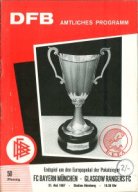
The game was between Rangers (whom I assumed were from Canada) and Bayern Munich (could have been from anywhere). The event was the European Cup Winner’s Cup Final.  Dad explained it had been the previous season’s equivalent of the FA Cup winners in various European countries in a knock-out competition.  The cup doesn’t exist anymore and has gone the way of other pan-European tournaments like the Inter-Toto cup (Toto split from Inter and went on to record “Africa”).  Chelsea weren’t going to compete in that next season, obviously, which highlighted my need to change footballing support.

The game started at 7.30 PM (perilously near bedtime). I didn’t care that I was unaware of the competition, both teams meant nothing to me – I was in my jim-jams, but allowed to watch TV.  It was on this evening that I had a Damascene moment and realised there was a God – and he was possibly German.  The game was 0-0 after 90-minutes.  Dad realised the importance of the game (I couldn’t give a monkey’s – I was staying up late).  Extra time started (as far as I was concerned it was probably nearly time to get up it was so late) and after 109-minutes Bayern Munich scored.  The score remained at 1-0. Bayern had won the mouthful tournament the European Cup Winner’s Cup.  A team of winners.  I went to bed after ten o’clock, with, I swear, it was just getting light.

So, glory seeking it would be and the team I would support would be the team not from Canada, Bayern Munich.

During the following few seasons I wondered why Bayern Munich were never on March of the Day or The Big Match.  Wolverhampton Wanderers seemed to be on it a lot but they’d not won anything in Europe.  Derek Dougan wasn’t even singing the song for the Northern Ireland Eurovision Song Contest entry.

There was no such thing as the internet those days (which may have affected my eyesight even more if there had have been) so no way of keeping up with my new team’s news. The absence from football programmes in the UK was a conundrum for me.

It wasn’t until we started learning O-level Geography at Bec Grammar and focussing on North West Europe that I realised exactly why Bayern Munich had never featured having David Coleman commentating on a cold Tuesday evening at Stoke. The glory seeking also kicked in during the 1970 World Cup finals in Mexico where six of the eleven West Germany players played for Bayern.

50 years on, Balham United possibly don’t even exist, Tooting & Mitcham have never threatened to win the Champions League, so continuation of following Bayern Munich has carried on. This is the sixteenth season I’ve had a season ticket and can say “where is the nearest chemist?” in German as well as my name, age and inside leg measurement.   I was there on Wednesday against the Arsenal and these days Thomas Müller has replaced his namesake Gerd as my hero. Auf geht’s Bayern (I think my clutch has gone).   If Bobby Tambling had scored a hat-trick on May 20th 1967, my Saturday morning travels would be slightly easier.  He didn’t, so 1,100-mile round journey every other weekend is now routine.
A lighthouse moment

north_forland_old1

I wasn’t terribly lucky with adventure-filled trips away with school or para-military organisation (my Cub group did go camping, but only in the field behind the church of St Mary’s on Balham High Road – about 100 yards away from where we’d weekly shout “dyb, dyb, dyb”. The field was still considered dangerous and we were inoculated against Dengue fever four weeks’ before.  There was always rumours Anthrax ad been placed there during the war).

I remember, when they were at school, paying for my kids to go to America, Israel, Berlin; I spent a week on school journey in 1968, in Cliftonville.

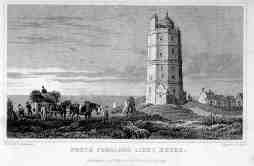
Cliftonville is a sub-district of Margate, on the Kent coast. In 1968 it was twinned with Roswell.  I remember two trips away for the minus-two-star hotel where we were staying: one was to the North Foreland Lighthouse.  I decided there and then that a career as a lighthouse keeper was unlikely.  Ironically, after failing my O-levels for the second successive time and my dad taking me to an industrial psychologist, I was told that perhaps a career in lighthouse-keeping might be on the cards as I knew what a lightbulb was.  And knew that a very big one was needed to make the lighthouse function.  He did asked me how many people does it take to change a lighthouse lightbulb, when I answered “fish” it was then that he suggested a career in advertising.

Looking back, I’d have enjoyed working alongside the Sirens who lure sailors onto the rocks on the East Kent coast. Although at just over eleven years of age the only siren I knew was the noise coming from one as I tried to sleep most evenings in my ground floor Du Cane Court flat, as the police arrived to attend to happenings in the dance club on Balham High Road opposite.

The second trip was to a farm. 100 yards away from the farm told me I’d not be making a point of tuning in each morning to listen to the programming on Radio 4.  The smell was like some form of olfactory torture.  There also, even at 11, seemed something really quite wrong with what was happening with cows’ udders on the farm.  There smell still lingers: like Virol and calamine lotion.

Secondary school trips at Bec Grammar were slightly more exotic. We went abroad twice.  This was pre-tunnel and we travelled by boat to Boulogne one year (and despite our behaviour on French soil) and Dunkirk, the following year.

Everyone wanted to buy flick-knives (those days they were more in evidence than croissants) and cigarette lighters, whose flames were based on those emitting from the oil rigs in the North Sea.

We were all packed off by our various mothers with enough supplies assuming we’d either we’d never return from this foreign field or they’d hope we’d introduce the French to the joys of family-sized packets of Custard Creams.

The French were never given this opportunity of sampling Custard Creams as all were eaten (as if hovered over by a judge with a stop-watch from the Guinness Book of Records); they were all consumed before the journey back. This is why, on the second journey, we were packed off with Joy Rides and Kwells.

Vive la France – where is the nearest chemist?

Bob-a-Job weak

bob-a-job-week

Even though the British Government passed the Abolition Act in 1833, one hundred and forty years on, slave labour was still very much in evidence in the form of small boys in shorts going from house to house offering their services (experienced or otherwise) for the price of a shilling (5p).

This was Bob-a-Job week, encouraging Cubs and Scouts (these were the days before Beavers – a name clearly resulting in the research group determining the name being made up entirely of adolescent males).

It would seem, after exhaustive research amongst my gym buddies, that I may have got off lightly with the tasks they had to do for a lowly shilling. I didn’t have to walk dogs (or lose them) nor peel the entire crop of Ireland’s potatoes in the early 60s. My task, given I lived in a block of over 600 flats in Balham, where animal ownership was not encouraged and there had been a potato blight whilst I was studying for my Signaller’s Badge, was relatively light.  I polished letterboxes; I didn’t lose a single golden retriever, nor did I prepare a single chip.

After these Herculean tasks were accomplished, the donor would hand over the shilling and sign the card you carried. The money earned went towards the needs of the Scout pack; I always dreamed of getting a bigger woggle, but surgery wasn’t as advanced as it is now.

The letterboxes in Du Cane Court, where I lived, were quite small (although luckily bigger than a Post Card) and therefore didn’t have much brass round them to clean. My nan and her sister lived in the flats too and were sufficiently menacing to ensure I had a large database upon which to work.  Other tenants would rather part with a shilling than have my nan eff and blind at them in the communal dairy or have my Auntie Vera threaten them with a lighted Embassy.

I still have allergic reaction to Duraglit and am currently suing the Scout Association.

I guess Bob-a-Job was a pre-cursor to Just Giving?

It was ionic that I’d have to charge a shilling for doing things round the flats whereas my mum did most activities for nothing. There was a woman who knew her woggles.