Flowers in the train

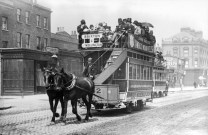
tram

One week back in Covent Garden, after nearly four decades away, I have discovered they’ve moved the London Transport Museum from Clapham.

As kids in the 60s we would walk the along the A24 (probably a Roman Road which linked Watling Street to Offa’s Dyke via Gaul) from my flat in Balham to the huge hangar which housed more trams than you can shake a stick at just past Clapham Common Station.   We walked, as this saved on the bus fare, plus we wanted to feel like Centurions.

No one was especially interested in 19th Century Tube trains, but it made a change from going to South Ken to see a blue whale, a dodo and a couple of coelacanths.

Also, in Covent Garden, there seem to be nicer shops than when I was last here. Indeed, the office where I was is now a Gap store.  When I’d worked there previously the only gap was in the window next to where I sat giving me the impression of feeling like Bert Trautmann for my eighteen months tenure in WC2.

One thing I have seen is a lot of men in black jackets carrying square-shaped brief cases – presumably they are carrying portable chess boards – there are a few who look like Bobby Fischer, although with handshakes that they’re giving out, would struggle to move any chess pieces!

Because of the theatres round here I’ve already seen various celebrities – yesterday I saw Mark Thatcher – I assume he’s in The Lion King? I guess it’s just a matter of time before I see Eliza Doolittle?

Perpetual balls

drinking bird

Last Monday I moved offices and pondered how the contents of my desk differed to that of my first desk, which was situated just off the Strand in 1974 (in an office building, obviously, not me sat, on the Strand, at a desk outside the Stanley Gibbons shop).

The fundamental change on my desk being there is a PC now and no sign of a Newton’s Cradle (certainly no drinking bird with its nodding head slowly filling up with (in my case) Civil Service tea) – a must for any executive desk (not that I was anything like an executive in 1974).

I did have a typewriter – for younger readers this was like a PC, only with slightly more dexterity needed to type, although it did come with a selection (red and black) of typewriter ribbons; sadly, it didn’t have Tetris.

As well as the example of conserving momentum and energy (who said physics was useless at school?), aside from Newton’s Cradles being on desks, during the 70s, there would always be some form of calendar involving wooden blocks; and if you really were an executive, an angle-poised lamp.

The most senior person in the room would possess the pencil sharpener – scarily not dissimilar to ones you’d have had at primary school, so talking to your boss always left with you the feeling that you’d hope you’d not be tested on your four times table.

But no executive desk was complete without having some form of balancing toy. The trick was to tap the toy and set off the perpetual motion without being too cack-handed and knock it off.  It would be the nearest any of us got to doing gymnastics.

Tomorrow I’m off round the shops in Covent Garden to seek out a 70s executive toy. I wonder if the drinking bird likes Irn Bru?

Titch and clackers

Clackers-clacker-balls-BLUE-Click-Clacks

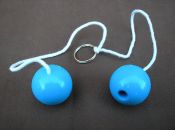
One of the most dangerous things in a London school playground in the 60s and 70s wasn’t the chance of getting cholera from the school fountain, it was clackers.

How did this get past any research group and actually make it into production?: “You get two, heavy when moving at 100 mph, plastic balls and bang them together”.  The noise was one thing, the potential wrist breaking a mildly bigger problem.

But these “toys” life didn’t last long within playgrounds, although during its reign of terror made the Eton Wall Game look like a cream tea with an elderly aunt.   They were soon banned; not by schools directly, the local hospitals were running out of supplies of plaster of paris.

During these times clackers were not the only life-threatening injury one could get in a playground: a hoop and a stick could, if out of control, crash into ankles and if not treated in time could easily turn to gangrene;  I was a connoisseur of cards inside bubble gum packets and here a paper cut courtesy of Alan Tracy coming out of the Roundhouse was always lurking when flicking said card up against the playground wall; conkers was always potentially dangerous if your opponent had a violent allergy to acetic acid.

I’ve not been in a primary school playground since 1968 but I’m assuming hop scotch is now played on an app; one potato, two potato is deemed offensive in case any participant in the playground’s relatives lived during the 1845 Irish famine and marbles are things you tend to lose now rather than play.

Three and in, anyone?

Michael Miles High Club

400px-Takeyourpick_gong_yesnogame

I miss “Take Your Pick” not being on on a Friday evening. I would sit with my nan in her Balham flat urging everyone to fail at every opportunity.

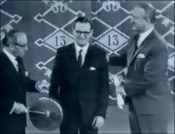
The first hurdle for the contestants was the yes/no interlude, when questions would be asked where the obvious Pavlovian response would have been yes or no. “Is the Pope Catholic?” being one of Michael Miles’ trickier questions.  If, after the longest minute of their life to date, the contestant had successfully avoided saying neither yes nor no, they’d be given five bob (25p in new money).  Five bob was double my pocket money in the sixties when Take Your Pick was aired and I believed that five bob could probably have bought the universe – certainly could have bought Rediffusion, the programme’s producers.

If the contestant failed, their ignominy was doubled by having former Pathé News newsreader, Bob Danvers-Walker, banging a gong next to them to make their ears bleed.

I especially enjoyed the climax of the show when the contestants could potentially win a booby prize. The use of the word booby on TV before 9.00 pm amused me.  I was only 11, I hasten to add.

During the show the contestants would have accumulated money and were faced with the ultimate choice of betting against their current winnings (take your pick – geddit?) – on offer by selecting “Box 13” – this could have been a holiday in Totnes, or something equally exotic or an aforementioned booby prize, like a mousetrap. It was when the word stress was first invented.

My nan and I would hope people would select “Box 13”; very few people did; no bad thing as some weeks inside was a three-headed dog who guarded the gates of Hell. Marginally worse than going to Totnes.


Ex-directories

telephone seat

There must be a massive market for old telephone seats?

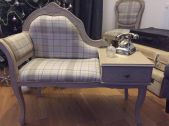
With the advent of modern phones there are several pieces of unwanted furniture no longer needed; the old-fashioned telephone seat, much loved in the 50s, 60s and 70s, is sadly one – along with locks on the phone, wires and telephone directories.

In London there were the four monster books; when they’d arrive you’d always check your own entry and then see if there were any rude names to ring. I was always disappointed to find there was no Mr Knob living within the London postal district.  They were great door-stops, but not very good if your telephone seat was bit wobbly at one end.

I was never encouraged to sit too long on the telephone seat as my mother told me this was how you got piles. Piles of what I always thought to myself not having been professionally trained in rectology?

But there was something even more dangerous than falling off an unbalanced seat or haemorrhoids: that was the address book – not a simple one you’d add people whom you’d met on holiday and would swap Christmas cards with for a respectable period of time until you realised that Hayling Island was a long way from London and did you really liked them? – the device with the letters down the side, which, when pressed, opened up at a speed like that of a hunting cheetah.  If you had bad eye-sight, like me, you’d need to be close to check the number you were about to ring – consequently there was always the danger of just prior to making a call, you’d re-enacted the most famous bit of the Battle of Hastings.

I often dreamed of being able to rip a London telephone directory in two. I clearly never followed the instruction manual which came with my Bullworker that accurately.

Rings a bell

telephone

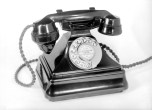
You no longer have to answer phones with your number.   Somehow reciting the words “Balham 0557” still rings (no pun intended) favourably with me and was gutted when, sometime in the 60s, the Balham prefix BAL changed to the very impersonal 673 – where is the magic with that?  At least make it 666 – infinitely more comedic; the telephone exchange number of the Beast!

I had an aunt who had a phone voice; if you rang her she started off as Princess Margaret and if she knew who you were would instantly (subsequently moving several rungs down the ascendancy to the Throne scale) became Margaret Powell (who might have driven a Princess, but certainly wasn’t one).

My family’s first phone was red and was a step up from the yoghurt pots and string we’d owned before; although more expensive, you never got cross lines on a yoghurt pot and there were no party lines either – it was YOUR yoghurt pot – no waiting for the old woman downstairs to come off the phone to the chimney sweep.

Until Trimphones came along phones were quite cumbersome – only slightly smaller than the Colossus built at Bletchley Park.   The receivers were good, however, if you wanted to practice rounders in your lounge.

Phone boxes aren’t as popular as they were, either. No wonder there are loads of ads on TV for printing your own business card, the former major advertisers within phone boxes now (allegedly) use the Internet.  And pressing “Button B to get your money back” was how fruit machine addiction began.

“Putting you through now, caller.”

The postman doesn’t even ring once!

postcard

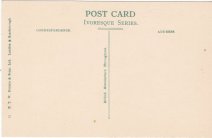
Around this time of year, when I was growing up in London in the 60s and 70s, I’d anticipate copious amounts of postcards from friends and relatives arriving showing pictures of a place within the town they were staying where they’d never visit, but locally it was iconic, and/or telling me they wished I was there (which begs the question: why wasn’t I invited in the first place?)

Cards would come from far-reaching places such as Bognor, Bournemouth, Bideford – having been brought up in Balham it seemed that my friends and relatives were incapable of travelling anywhere which didn’t begin with a “B”. (These days people will travel to Belize, Bolivia, Bogota – nice, but do they do a nice cream tea there?)

No one sends postcards anymore; instead of “wish you were here” on the back of a card featuring a beach, historical monument or a cartoon of a large-breasted woman berating her diminutive husband with an innuendo like “why can’t your sand castle be that big?” you get a text or an email which says: “arrived safely”, swiftly followed by over a hundred Instagram photos of the baggage retrieval area of some distant airport and bemoaning the fact that why is it so few people speak English in the Belgian Congo?

One of the last postcards I sent was in 1973, around this time of year, wishing that my mum and dad were here and hoping I’d done well in my O-levels.  I hadn’t; the punishment being the next year with two weeks in Benidorm – also beginning with B – like Bubonica Pestis (a little-known Greek island).

Spud-U-Dislike

sekiden 2

I’ve never touched an actual gun, courtesy of there having been no second amendment in the 1904 Balham Constitutional Club founding declaration.

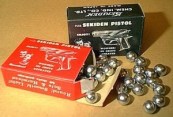
As a kid, however, to protect myself from strangers and head of my one-man vigilante group, I did possess a Sekiden gun. I also owned fifty silver balls (these were the Sekiden gun’s ammunition not something I’d miraculously acquired during one of my many hernia operations).

Before you could progress to owning a Sekiden gun, you’d have to prove your responsibility with a spud gun (it is an apocryphal thought that the 1845 Irish Famine was caused by the over-use of spud guns within the Emerald Isle).

Armed with my spud gun and a couple of potatoes past their sell-by date courtesy of the Du Cane Fruiters, I would stalk my south London flats seeking out the cleaners – their sole protection being a mop, set of rubber gloves and a tin of Duraglit. Luckily for them my aim was less Jack Ruby more Ruby Murray.

Balham was a gun-free zone as far as I knew growing up in the 60s and the biggest chance of dying was of embarrassment if you’d had your jeans bought for you from the local Tesco Home ‘n’ Wear.

Steering committee

steering wheel

As a Christmas present in 1963 I was given a pretend steering wheel.

This was jointly given to me by my mother, who’d passed her driving test the previous months in fog, snow and hot pants and my father who, after a span of twenty years consisting eleven unsuccessful and one complete freak of driving nature successful driving tests.

I inherited my father’s poor driving ability and really should never have progressed to anything further than a pretend steering wheel made of light plastic, not having any electrical power and only able to affix itself to something with the use of a big rubber sucker.

My steering wheel had many levers. One was the indicator (this is something Volvo drivers won’t understand) and a gear stick; this often came off in my hands, but had an extra use as I’d emulate my dad’s road rage by shaking the detached gear stick at passing (invariably innocent) drivers. In the middle of the wheel sat a hooter, which sadly didn’t play Colonel Bogey’s March when pressed.

I enjoyed making the noises small children think cars make and would couple this by copying my vituperative father. It brought pretend driving to life for me; Dad put the F in Ford.

I failed my first driving test in Sutton. Having to sit next to a complete stranger AND having no plastic steering wheel to manoeuvre were distinct disadvantages; saying “parp, parp, said Noddy” as we did the emergency stop didn’t exactly help my case.

A nod’s as good as a wink to a Ford Cortina

ford-cortina-1600E

There was a time when Kensington Olympia was the gateway to Devon. All you needed was a nervous driver, a Ford Cortina and a Motorail.

In the summer of 1972 I was taken, by my dad, from our home in Balham to Kensington Olympia – the Motorail terminus. I sat in the back of my uncle’s Ford Cortina as we travelled the 100-yards to board the Motorail.  When we parked and my uncle had applied the handbrake I remember thinking that Devon was not all it had been set up to be and the beach smelled of exhaust fumes; there wasn’t a cream tea in sight, either.  Having never been to Devon before, it looked suspiciously like West London.

I didn’t have to spend the entire time in the Ford Cortina – my only companion, after my uncle had got out of the now stationary car, was the model dog in the back of the car. Not much conversation, although it did seem to agree with everything I said; it certainly nodded a lot!

I realised, after what had seemed an eternity, that Dawlish was the end destination. Luckily the house where I stayed backed onto the railway line, so it felt, for the entire fortnight, that I was still on the Motorail.

I rarely went on holiday with my dad; but he would visit for the odd day. He made a special effort this holiday to come to Devon as he’d heard Dawlish were playing a Chelsea XI in a pre-season friendly.  I subsequently realised my dad was more interested in Marvin Hinton than me.  More Marvellous Marvin than Marvellous Micky.

The Motorail no longer runs, probably because Ford Cortinas are no longer that popular. As are nodding dogs.